CMMI Level 3 Certification in India
Reach CMMI Maturity Level 3 with a CMMI Institute partner that has its own Lead Appraiser. One team takes you from gap analysis to a published Level 3 rating, for Development, Services or both.
Contact Us
If a tender document, an RFP or a client's vendor questionnaire has asked whether your company is CMMI Level 3, you are in familiar company. Maturity Level 3 is the level named most often by Indian government departments, public sector undertakings, banks and overseas enterprise buyers when they shortlist software and IT services suppliers. It tells the buyer something simple: your delivery does not depend on one strong project manager. It depends on a defined way of working that the whole organisation follows.
CMMI Level 3 certification is how you prove that. It is earned through a formal appraisal of your live projects, led by an ISACA-certified Lead Appraiser, and the result is published in a public registry that any client can check.
Univate Solutions is a CMMI Institute partner with a CMMI Lead Appraiser on its own leadership team. We have taken Indian companies such as HealthRecon Connect and Infotrack Telematics to Level 3, and Ceinsys Tech to Level 5. This page explains what CMMI Level 3 means, who needs it, what the appraisal involves, how long it takes and how we support you at each stage.
What Is CMMI Level 3?
CMMI Level 3, also called Maturity Level 3 or the Defined level, is the third of five maturity levels in the Capability Maturity Model Integration (CMMI) framework owned by ISACA. An organisation at Level 3 runs its projects on one documented set of standard processes. Each project tailors those processes to its own needs, but only within rules the organisation has agreed.
At Level 1, work gets done through individual effort and results are hard to predict. At Level 2, each project is planned and tracked, but two projects in the same company may work in very different ways. At Level 3, the organisation owns the process. Estimation, requirements, design, reviews, testing, risk management and training all follow a common playbook, and lessons from one project feed back into that playbook for the next team.
What Does It Mean When a Company Is CMMI Level 3?
For a buyer, a CMMI Level 3 company is a lower-risk supplier. An independent appraisal team has examined real project evidence and interviewed the people doing the work, and has confirmed that defined processes are actually being followed across the organisation. Quality is built into how the company works, not left to chance.
Is CMMI Level 3 a Certification?
CMMI Level 3 at a Glance
| Item | Detail |
|---|---|
| Official name | Maturity Level 3, Defined |
| Model | CMMI V3.0, owned by ISACA and administered by the CMMI Institute |
| Model views | Development (DEV), Services (SVC), or both in one appraisal |
| How it is awarded | Benchmark Appraisal led by an ISACA-certified Lead Appraiser |
| Proof | Public listing in ISACA PARS |
| Validity | 3 years. A Sustainment Appraisal can extend it by 2 more years |
| Typical timeline | 6 to 12 months from gap analysis to rating |
| Typical fit | IT, software, engineering and services organisations bidding for enterprise and government work |
CMMI Level 3 Certification Services from Univate
Most companies that approach us already deliver good work. What they lack is a defined, organisation-wide process that an appraisal team can see in action. Our job is to close that gap without burying your teams in paperwork.
A Univate engagement covers the full journey. We begin with a gap analysis against the CMMI V3.0 Practice Areas for your chosen view. We then work with your process group to define or tighten the standard processes, templates, tailoring guidelines and measures that Level 3 expects. Your project teams are trained and coached while they apply these on live projects, because an appraisal is based on evidence from real work. Before the formal event we run a readiness review that mirrors the appraisal, so there are no surprises. Finally, the Benchmark Appraisal is planned and conducted under an ISACA-certified Lead Appraiser, and your rating is submitted for publication in PARS.
- Gap analysis and Level 3 roadmap
- Process definition, tailoring guidelines and a process asset library
- Measurement plan and organisational metrics repository
- Role-based training for practitioners, project managers, QA and leadership
- Project coaching and internal process audits
- Readiness review and mock interviews
- Benchmark Appraisal and PARS publication
- Sustainment support and a path to Level 4 and Level 5
Not sure whether you are closer to Level 2 or Level 3?
Share your team size and the tender or client requirement. We will tell you which level is realistic, how long it should take and what it will cost.
Who Needs CMMI Level 3 Certification?
CMMI Level 3 is rarely pursued for its own sake. There is almost always a commercial trigger. The most common one in India is a tender. Central and state government departments, PSUs, smart city projects and large banks often list CMMI Level 3 as an eligibility condition or award technical marks for it. If you do not hold the rating on the bid date, the rest of your proposal may never be read.
The second trigger is export business. Buyers in the United States, Europe and the Middle East use CMMI as a quick filter for offshore partners, particularly for software development, application maintenance, testing and managed services. The third is growth: companies that have grown from thirty people to three hundred find that informal habits now produce missed estimates, uneven quality and heavy dependence on a few senior people. Level 3 gives them a structure that scales.
| Type of Organisation | Usual Trigger | Model View |
|---|---|---|
| Software development and product engineering companies | Government, PSU and BFSI tenders. Overseas enterprise clients | Development |
| IT services, application support and managed services providers | Vendor qualification by large enterprises. SLA-driven contracts | Services, or Development and Services together |
| BPO, KPO and shared services centres | Client audits and contract renewals | Services |
| Engineering R&D, embedded, automotive and telematics firms | OEM and tier 1 supplier requirements | Development |
| Healthcare IT and health data services | Overseas client due diligence | Development or Services |
| GIS, e-governance and system integration companies | Tender eligibility and technical scoring | Development and Services |
| Startups and scale-ups moving into enterprise sales | Large customer procurement checks | Development |
When Level 3 Is Not the Right First Step
We will tell you if Level 3 is too early. A small team with no consistent project planning or tracking usually gains more from a Level 2 appraisal first, with Level 3 planned for the following year. Equally, if your tender names Level 5, we will plan for high maturity from the start so that measurement data is collected early. Choosing the right target is part of the free consultation.
Benefits of CMMI Level 3 Certification
The first benefit is access. A published Level 3 rating clears the eligibility gate in tenders and vendor assessments that you would otherwise be shut out of, and it earns technical marks where maturity is scored. For many of our clients, one contract won on the strength of the rating pays for the whole programme.
The second benefit is predictability. Level 3 asks you to estimate using historical data, review work products before they move downstream, manage risks from the start and measure what matters. Projects slip less often, defects are caught earlier and customers see fewer surprises. Management gains a consistent view across projects because every team reports the same measures in the same way.
The third benefit is resilience. When the way of working lives in an organisational process and not in a few people's heads, new joiners become productive sooner, attrition hurts less and teams in different cities can work as one. That same foundation makes ISO 9001, ISO 27001 and ISO 20000-1 easier to maintain, and it is the base you need if you plan to move to Level 4 or Level 5 later.
What the Data Says
ISACA's CMMI Technical Report on Performance Results draws on more than 9,500 appraisals carried out between 2019 and 2022 across 100+ countries. Average improvements among appraised organisations:
Source: ISACA, CMMI Technical Report: Performance Results (2023).
CMMI Level 3 Requirements: What You Need in Place
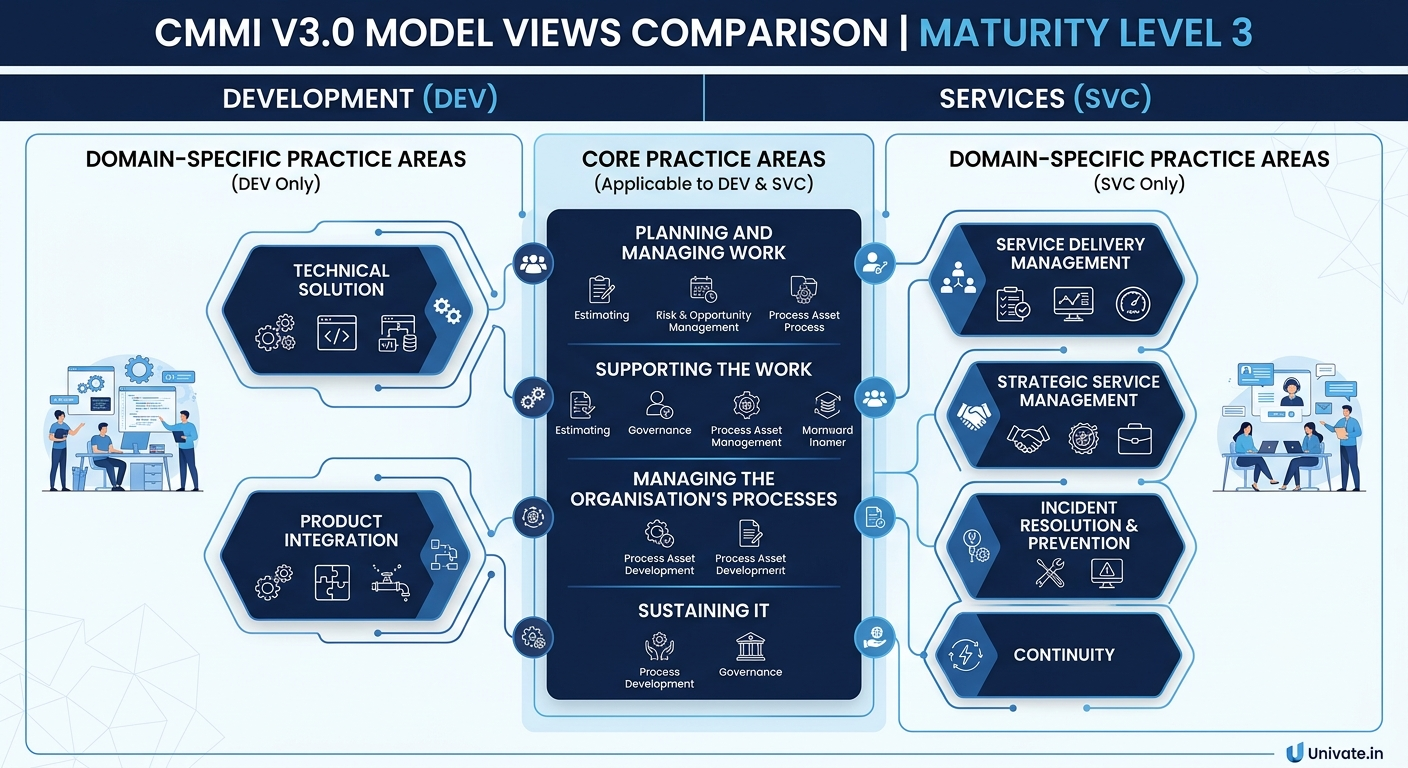
CMMI V3.0 is organised into Practice Areas. Each Practice Area contains practices grouped by level. To be rated at Maturity Level 3, your organisation must satisfy the practices up to level 3 in every Practice Area that falls within your chosen view. Seventeen core Practice Areas apply to every organisation. The Development view adds Technical Solution and Product Integration. The Services view adds Service Delivery Management, Strategic Service Management, Incident Resolution and Prevention, and Continuity.
Compared with Level 2, Level 3 brings in the organisational Practice Areas: process improvement managed as an ongoing activity, a library of standard process assets, a training programme linked to those processes, structured risk and opportunity management, peer reviews, and verification and validation of work products.
| Area | Practice Areas Involved | What the Appraisal Team Expects |
|---|---|---|
| Planning and managing work | Estimating, Planning, Monitor and Control, Risk and Opportunity Management | Estimates based on organisational data, plans tailored from the standard process, risks tracked from the start |
| Engineering and delivery | Requirements Development and Management, Technical Solution, Product Integration, Peer Reviews, Verification and Validation | Traceable requirements, reviewed designs and code, planned testing and recorded results |
| Service delivery (Services view) | Service Delivery Management, Strategic Service Management, Incident Resolution and Prevention, Continuity | Agreed service levels, incident handling and prevention, tested continuity plans |
| Supporting the work | Configuration Management, Process Quality Assurance, Decision Analysis and Resolution, Causal Analysis and Resolution | Controlled baselines, objective process audits, reasoned decisions, root causes addressed |
| Managing the organisation's processes | Process Management, Process Asset Development, Organizational Training, Managing Performance and Measurement | A process improvement plan, a process asset library, a training plan and an organisational measurement repository |
| Sustaining it | Governance, Implementation Infrastructure | Senior management reviews, funding and resources, processes that persist when people change |
How to Prepare for a CMMI Level 3 Appraisal
Preparation is mostly about making good practice visible and consistent. Before you engage an appraisal team, confirm that the following are true for your organisation:
- A process group or named process owner exists and has management backing
- Standard processes cover the full lifecycle, from proposal or intake to delivery and closure
- Tailoring guidelines explain what a project may change and what it may not
- A process asset library holds templates, checklists, examples and lessons learnt
- Projects of different sizes and types have followed the defined process for at least a few months
- Measures such as effort, schedule, defects and review coverage are collected the same way across projects
- People have been trained in the processes they use, and training records exist
- Internal process audits have been run and their findings closed
The evidence an appraisal team reviews is ordinary project output: plans, estimates, requirement and design documents, review records, test results, risk registers, status reports, configuration baselines, audit reports, training records and minutes of management reviews. Nothing needs to be created only for the appraisal.
The CMMI Level 3 Certification Process
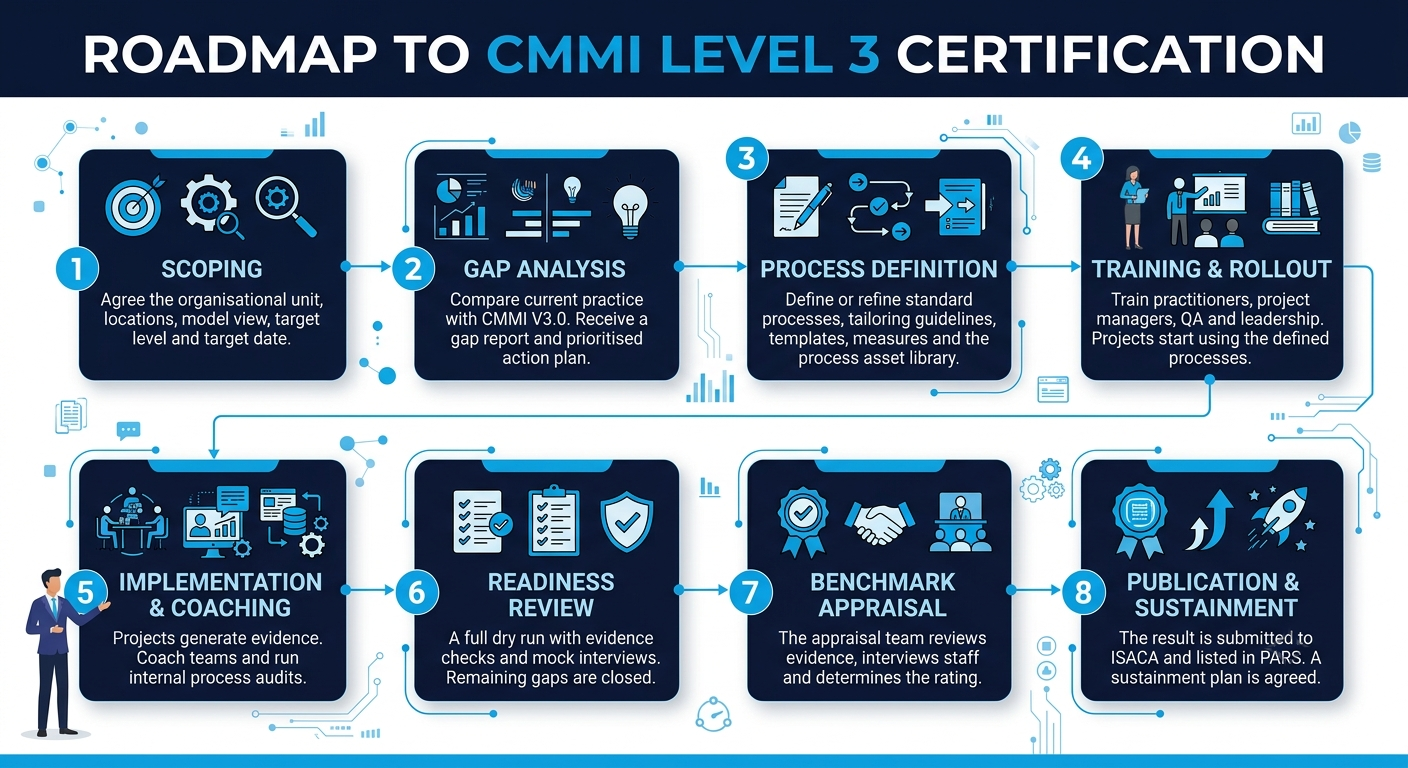
Every engagement is planned backwards from your target date, whether that is a tender submission, a contract renewal or a board commitment. The steps below apply to Development and Services alike. Durations depend on your size and on how much is already in place.
| Step | What Happens | Typical Duration |
|---|---|---|
| 1. Scoping | Agree the organisational unit, locations, model view, target level and target date | 1–2 weeks |
| 2. Gap analysis | Compare current practice with CMMI V3.0. You receive a gap report and a prioritised action plan | 2–3 weeks |
| 3. Process definition | Define or refine standard processes, tailoring guidelines, templates, measures and the process asset library | 6–10 weeks |
| 4. Training and rollout | Train practitioners, project managers, QA and leadership. Projects start using the defined processes | 4–6 weeks |
| 5. Implementation and coaching | Projects generate evidence. We coach teams and run internal process audits | 3–5 months |
| 6. Readiness review | A full dry run with evidence checks and mock interviews. Remaining gaps are closed | 2–3 weeks |
| 7. Benchmark Appraisal | The appraisal team reviews evidence, interviews staff and determines the rating | 1–2 weeks |
| 8. Publication and sustainment | The result is submitted to ISACA and listed in PARS. A sustainment plan is agreed | 2–4 weeks |
What Happens During the Benchmark Appraisal
The Benchmark Appraisal is the formal event that decides your rating. It is led by an ISACA-certified Lead Appraiser supported by trained appraisal team members, some of whom are usually from your own organisation. The projects and support functions to be examined are selected through ISACA's appraisal system, so a company cannot put forward only its best project.
The team studies your process documents and project evidence, then interviews the people who do the work: developers, testers, project managers, service desk staff, QA, trainers and senior management. They are checking one thing: does what people say and what the evidence shows match the defined process? Findings are shared with you before the final rating is decided, and the result is then submitted to ISACA for quality review and publication.
SCAMPI A or Benchmark Appraisal?
Many tender documents and older articles still mention SCAMPI A. That was the appraisal method used with CMMI V1.3. Under CMMI V2.0 and V3.0 it has been replaced by the Benchmark Appraisal, which serves the same purpose. If a tender asks for a SCAMPI A result, a current Benchmark Appraisal rating at Maturity Level 3 is what satisfies it.
Have a tender date in mind?
Tell us the date and we will plan backwards from it. You will get a realistic schedule and a fixed quote before you commit.
CMMI Level 3 Timeline and Cost in India
Most organisations reach Maturity Level 3 in 6 to 12 months. Teams that already run ISO 9001 or disciplined Agile delivery often finish in 4 to 8 months, because much of the raw material already exists. The one thing that cannot be compressed is evidence: projects need to have followed the defined processes for long enough to show that they are part of normal work.
Be cautious of anyone who offers CMMI Level 3 in a few weeks or for a few thousand rupees. A genuine rating always involves an ISACA-certified Lead Appraiser, a formal appraisal of live projects and a public listing in PARS.
The cost has two parts. The first is consulting: gap analysis, process definition, training, coaching and readiness review. The second is the appraisal itself, which includes the appraisal team's time and the fees payable to ISACA. Univate does not publish a generic price because the honest answer depends on your situation. After a free assessment you receive a fixed, all-inclusive quote with the appraisal fee included.
| Factor | Why It Matters |
|---|---|
| Size of the organisational unit | More people and projects mean a larger evidence sample and a longer appraisal |
| Number of locations | Each site in scope adds coordination and interviews |
| Model view | Development and Services together cover more Practice Areas than one view alone |
| Current maturity | Companies with ISO 9001, ISO 27001 or a working QA function start further ahead |
| Internal ownership | A named process owner with time set aside shortens the programme |
| Target date | Compressed schedules need more consultant days in a shorter period |
For a fuller breakdown, see our guide to CMMI certification cost in India.
CMMI Level 3 vs Other CMMI Maturity Levels
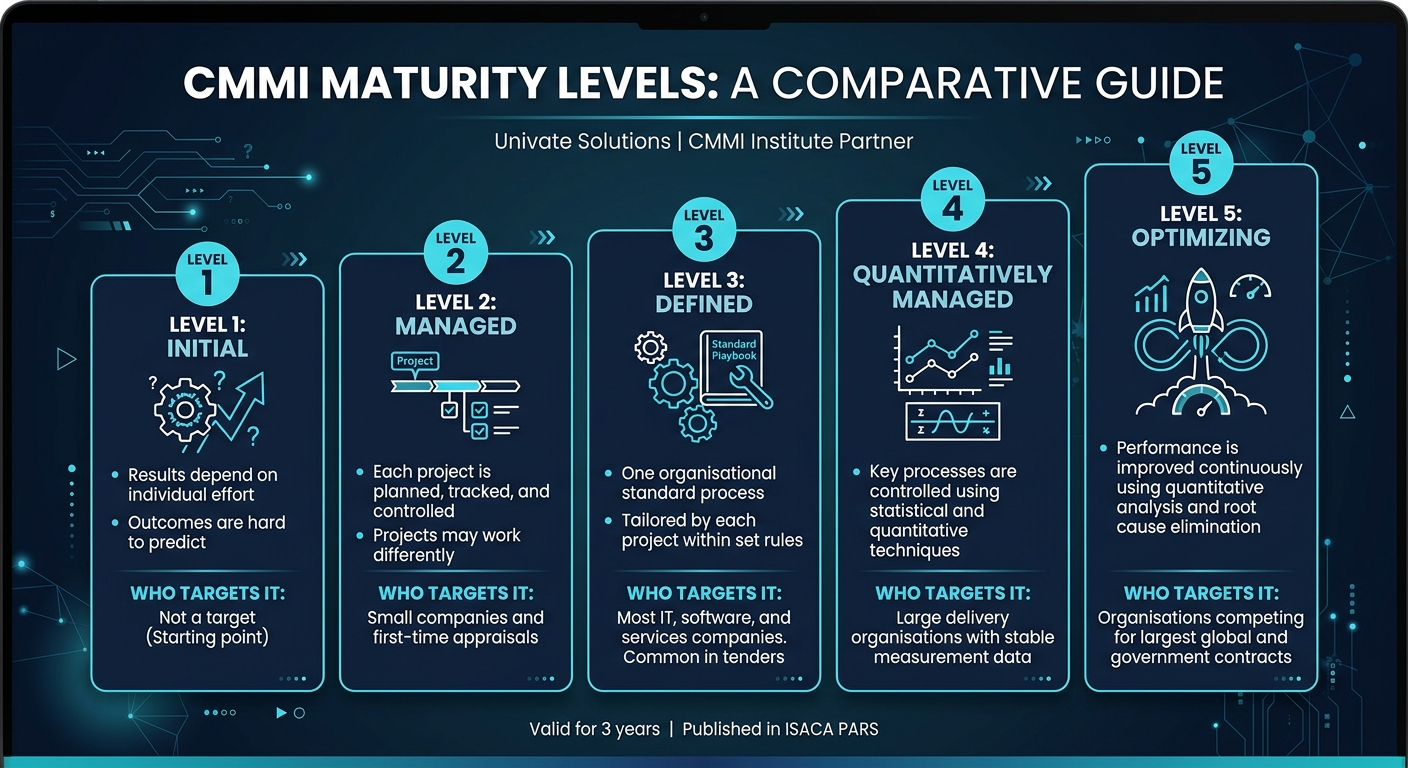
CMMI has five maturity levels, and each one builds on the level below it. You cannot be rated at Level 3 unless you also meet everything in Level 2, and you cannot reach Level 5 without the organisational base that Level 3 provides.
| CMMI Level | Name | How Work Gets Done | Who Usually Targets It |
|---|---|---|---|
| Level 1 | Initial | Results depend on individual effort. Outcomes are hard to predict | Starting point. Not something to target |
| Level 2 | Managed | Each project is planned, tracked and controlled, but projects may work differently | Small companies and first-time appraisals |
| Level 3 | Defined | One organisational standard process, tailored by each project within set rules | Most IT, software and services companies. The level most tenders name |
| Level 4 | Quantitatively Managed | Key processes are controlled using statistical and quantitative techniques | Large delivery organisations with stable measurement data |
| Level 5 | Optimizing | Performance is improved continuously using quantitative analysis and root cause elimination | Organisations competing for the largest global and government contracts |
CMMI Level 2 vs Level 3
The move from Level 2 to Level 3 is a move from project discipline to organisational discipline. At Level 2 a good project manager can carry a project. At Level 3 the organisation provides the process, the templates, the training and the measures, and every project starts from them. Ownership shifts from individual managers to a process group with management sponsorship. This is why Level 3 takes longer than Level 2: you are changing how the company works, not just how one project is run.
CMMI Level 3 vs Level 5
Level 5 is not simply more of Level 3. High maturity adds statistical thinking. At Level 4 and Level 5 the organisation builds process performance baselines and models, sets quantitative objectives and uses data to predict outcomes and choose improvements. That needs a year or more of clean measurement data, which is why most companies achieve Level 3 first. If Level 5 is your goal, we design the Level 3 measurement system with that in mind so that nothing has to be rebuilt later.
Can You Go Straight to Level 3 Without a Level 2 Rating?
Yes. There is no rule that you must hold a Level 2 rating first. A Level 3 appraisal examines the Level 2 practices as well, so many Indian companies begin directly at Level 3 when their tenders require it. What matters is whether your current practices and timeline support it, and the gap analysis answers that question.
To understand all five levels in more depth, read our guide to CMMI maturity levels.
CMMI Level 3 for Development, Services or Both
Your rating is always tied to a model view, and tender committees do read the fine print. A company that builds software should hold a rating in Development. A company that runs support desks, managed services or business processes should hold one in Services. Many Indian IT companies do both kinds of work, and for them a single appraisal covering Development and Services is more efficient than two separate appraisals.
| Aspect | CMMI Development (DEV) | CMMI Services (SVC) |
|---|---|---|
| Best suited to | Software, product engineering, embedded and system integration work | IT services, application support, managed services, BPO and shared services |
| Domain-specific Practice Areas | Technical Solution, Product Integration | Service Delivery Management, Strategic Service Management, Incident Resolution and Prevention, Continuity |
| Evidence comes from | Development projects and releases | Service contracts, service desks and operations teams |
| Often paired with | ISO 9001 and ISO 27001 | ISO 20000-1 and ISO 27001 |
| Common in tenders for | Application development and e-governance projects | Operations, maintenance and facility management contracts |
Learn more about CMMI for Development and CMMI for Services.
CMMI Level 3 with Agile, DevOps and ISO Standards
A common worry is that CMMI will force Agile teams back into heavy documentation. It does not. CMMI describes what needs to be achieved, not how. Backlogs, sprint plans, definition of done, pull request reviews, automated tests and retrospectives are all valid evidence for the relevant practices. In our experience, Agile and DevOps teams often reach Level 3 faster, because their tools already record most of what an appraisal team wants to see.
ISO standards and CMMI also sit comfortably together. They answer different questions, and many tenders ask for both. We regularly run CMMI with ISO 9001, ISO 27001 or ISO 20000-1 as one programme, so that policies, audits, training and management reviews are done once and serve all of them.
| Aspect | CMMI Level 3 | ISO 9001 | ISO 27001 |
|---|---|---|---|
| What it shows | Maturity of delivery and organisational processes | A working quality management system | A working information security management system |
| Outcome | Maturity level rating in ISACA PARS | Certificate of conformity | Certificate of conformity |
| Who decides | ISACA-certified Lead Appraiser and appraisal team | Accredited certification body | Accredited certification body |
| Validity | 3 years | 3 years with annual surveillance audits | 3 years with annual surveillance audits |
| Depth in software and services delivery | High | General, applies to any industry | Focused on security |
| Where buyers ask for it | IT and engineering tenders, offshore vendor selection | Almost all tenders | IT, BFSI and data handling contracts |
How to Verify a CMMI Level 3 Rating
Because CMMI Level 3 carries weight in tenders, the market also has offers that are not genuine. The safeguard is simple. Every valid rating is listed in ISACA's Published Appraisal Results System, which anyone can search by organisation name. A genuine listing shows the organisation, the model view, the maturity level achieved, the Lead Appraiser and the expiry date.
If you are evaluating a vendor, or choosing a consultant for your own company, check these points:
- The rating appears in PARS under the company's legal name
- The model view matches the work being bought — Development or Services
- The appraisal has not expired
- The appraisal was led by an ISACA-certified Lead Appraiser, working through a CMMI Institute partner
A certificate that cannot be found in PARS is not a CMMI rating, whatever it says on paper, and tender committees increasingly check.
Why Level 3 Programmes Stall and How We Prevent It
Most delays come from a handful of causes, and all of them can be avoided with early planning.
A thick process manual copied from elsewhere will not survive the interviews, because people cannot describe a process they do not follow. We build on what your teams already do and change only what needs to change.
If projects begin using the defined process two months before the appraisal, there is not enough history to show. We get pilot projects running early, even while the remaining processes are still being refined.
Level 3 looks at governance, and the appraisal team will interview senior management. When leadership reviews progress regularly and gives the process group time and authority, programmes finish on schedule. When they do not, programmes drift.
Many companies collect data but do not use it. Level 3 expects organisational measures that are defined once, collected consistently and used in decisions. We help you choose a small set of measures that management actually wants to see.
Why Choose Univate for CMMI Level 3
Univate Solutions is a CMMI Institute partner, and our CEO, Bansi Rath, is an ISACA-certified CMMI Lead Appraiser. That matters because the people who coach your teams understand exactly how an appraisal team reads evidence and what it asks in interviews. We have supported organisations from first-time Level 2 appraisals through to multi-model Level 5 appraisals covering Development and Services together.
After Level 3: Keeping and Extending Your Rating
A Level 3 rating is valid for three years from the date of the appraisal. Before it expires you can either go through a new Benchmark Appraisal or, if you qualify, a shorter Sustainment Appraisal that extends the rating by two years. Tender committees check expiry dates, so renewal should be planned at least six months ahead.
The years between appraisals are where the real value is created. Companies that keep running internal audits, management reviews and process improvement cycles find renewal straightforward. Those that stop often have to rebuild. Univate offers light-touch sustainment support, and when you are ready, a planned move to Level 4 and Level 5 through our high maturity training and consulting.
CMMI Level 3 Certification Across India
We work on site with clients across the country, supported by our offices in Bengaluru, Mumbai, Chennai, Delhi NCR and Bhubaneswar. If you are looking for local support, see our pages for CMMI certification in Bangalore, Mumbai, Pune, Hyderabad, Chennai, New Delhi, Noida, Gurugram, Ahmedabad and Indore. Multi-location companies can be covered in a single appraisal when the sites share management and processes.
CMMI Level 3 Certification: Frequently Asked Questions
What is CMMI Level 3 certification?
Is a CMMI Level 3 company a good company to work with?
How much does CMMI Level 3 certification cost in India?
How long does it take to get CMMI Level 3?
How long is a CMMI Level 3 rating valid?
Can we go directly to CMMI Level 3 without a Level 2 rating?
What is the difference between CMMI Level 3 and Level 5?
Is CMMI Level 3 mandatory for government tenders in India?
Can a small company or startup get CMMI Level 3?
Does CMMI Level 3 work with Agile and Scrum?
Can CMMI Level 3 certification be done online?
How can I check whether a company is really CMMI Level 3?
Which companies in India are CMMI Level 3?
Start Your CMMI Level 3 Journey with Univate
Whether a tender deadline is approaching or you simply want delivery to be more predictable, the first step is the same: a clear view of where you stand today. Share your team size, the kind of work you do and your target date. Our CMMI team will come back with the right target level, a realistic timeline and a fixed quote.
Univate supports organisations across India through every stage of CMMI certification, from scoping and gap analysis to Benchmark Appraisal and ongoing sustainment. Book a free consultation and start building toward a published CMMI Level 3 rating.