ISO 27001 Certification in India
Contact Us
Get ISO 27001 Certification in India with Univate Solutions. Our ISO 27001 Certification programme is led by an in-house ISO 27001 Lead Auditor — not a junior consultant. Univate has guided more than 300 enterprises through cybersecurity and compliance, managing your accredited certification body so you work with one team from gap analysis to certificate. We helped Tahakuf Al Emarat run an integrated management system across ISO 9001, ISO 27001, and ISO 22301. Book a free consultation and get a fixed quote. Call +91 72599 45454 or WhatsApp us.
What Is ISO 27001 Certification?
ISO 27001 Certification is formal proof that your organisation's Information Security Management System (ISMS) meets the international ISO/IEC 27001 standard. An ISMS is the structured system of policies, processes, people, and controls through which your organisation identifies, manages, and reduces information security risks.
The standard is built on the CIA triad — Confidentiality, Integrity, and Availability — and requires organisations to protect information assets across all three dimensions systematically and demonstrably. ISO 27001 Certification signals to clients, regulators, and partners that your data protection controls have been independently audited by an accredited certification body, not just self-assessed.
ISO 27001 Certification requires a two-stage audit. Stage 1 reviews your ISMS documentation and readiness. Stage 2 verifies live implementation through evidence review and staff interviews — and results in the certificate if no major non-conformities are found. The certificate is valid for three years, with annual surveillance audits. Univate runs the full cycle: gap analysis, ISMS build, internal audit, Stage 1 support, Stage 2 support, and renewal.
ISO 27001:2022 — What Changed and Why It Matters
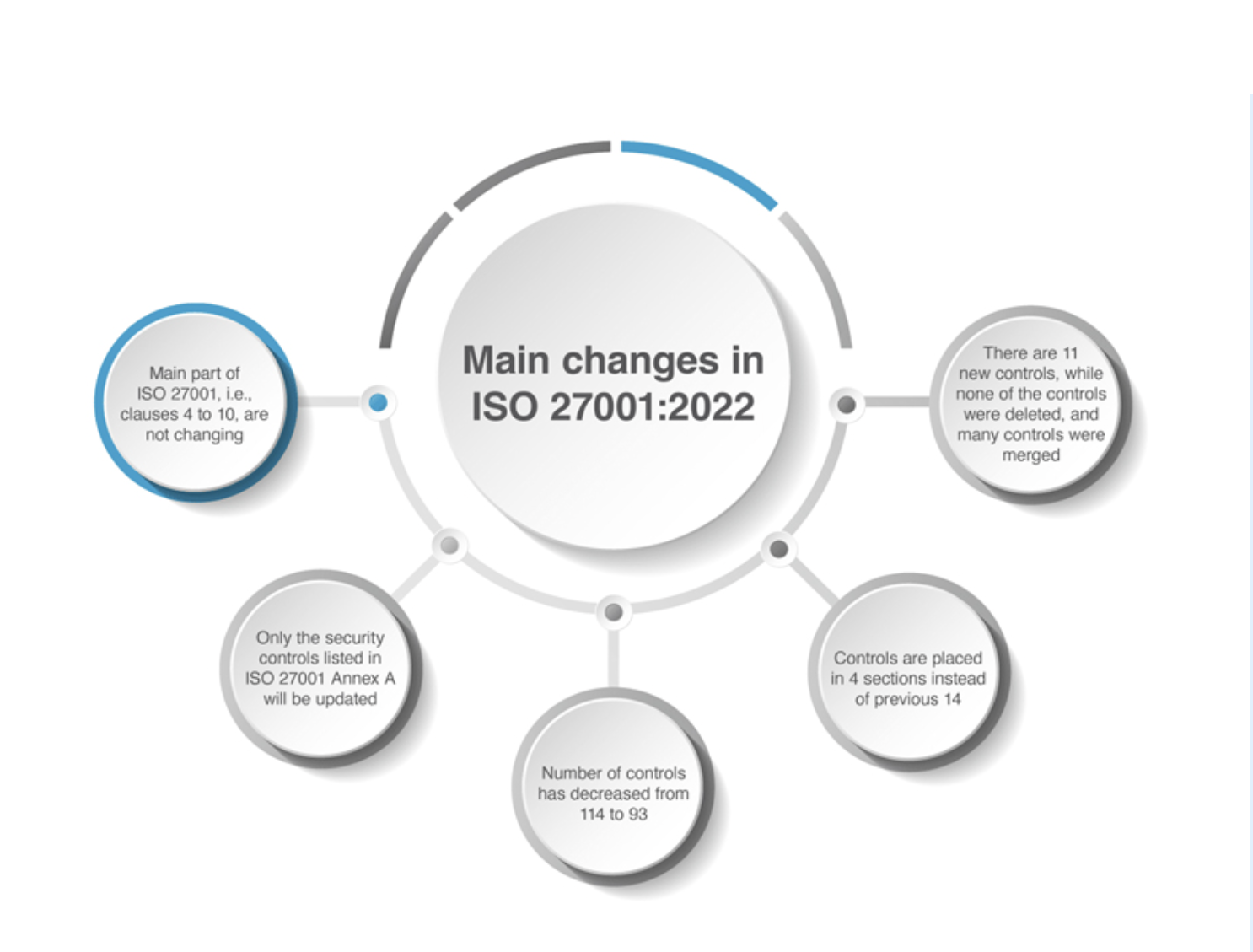
ISO/IEC 27001:2022 is the only active version of the standard. The most significant changes from the 2013 version affect Annex A — the control catalogue every certified organisation must reference.
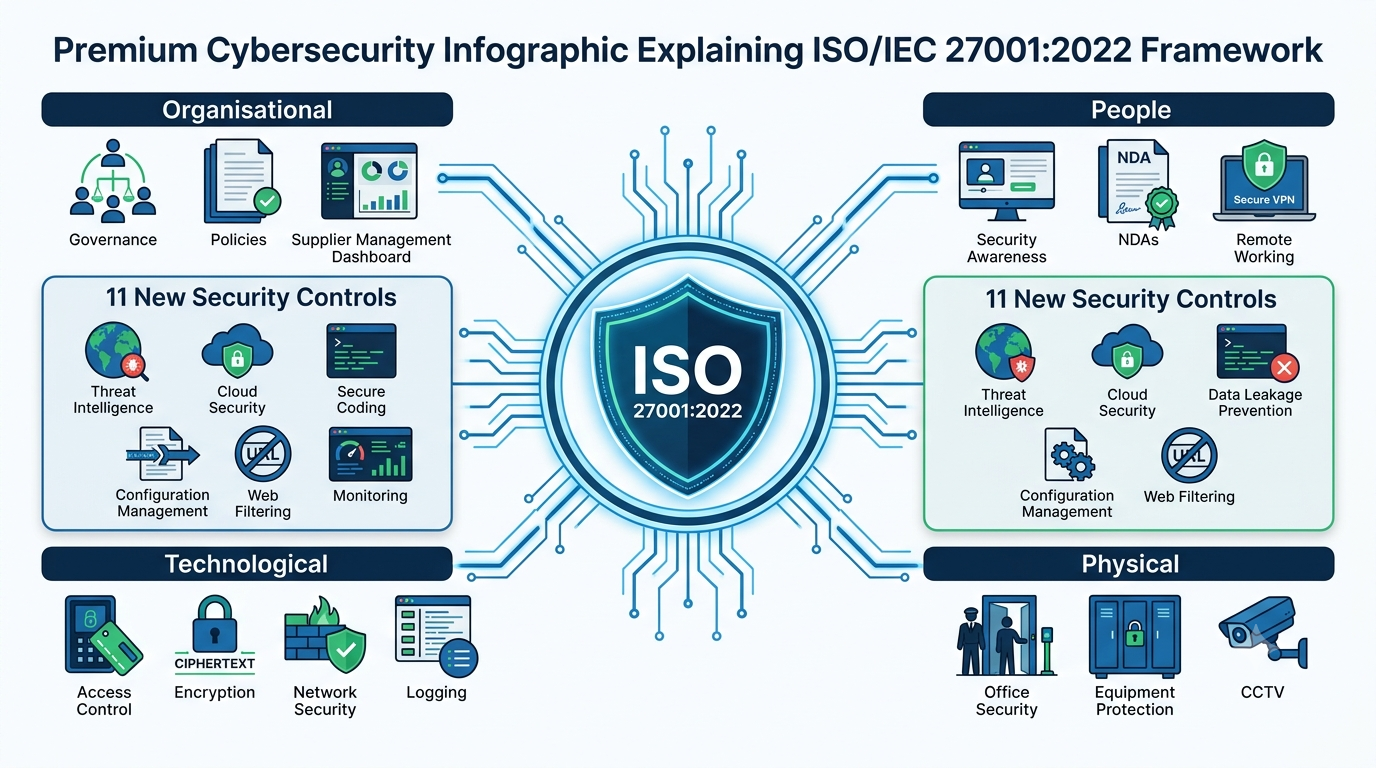
Annex A Restructured: 114 controls → 93 controls, 14 domains → 4 themes
| Theme | Controls | Focus Area |
|---|---|---|
| Organisational | 37 | Governance, policies, roles, supplier management, asset management |
| People | 8 | Screening, training, NDA, remote working, disciplinary process |
| Physical | 14 | Premises security, equipment protection, physical media |
| Technological | 34 | Access control, encryption, logging, network security, secure development |
11 New Controls Introduced in 2022
These reflect modern threat realities that the 2013 standard did not address:
ISO 27001 Requirements and Annex A Controls
ISO 27001 Certification requires both a working, risk-based ISMS and a two-stage audit by an accredited certification body. Clauses 4–10 are mandatory for all certified organisations.
| Element | What It Covers |
|---|---|
| ISMS scope (Clause 4) | The sites, systems, and data your ISO 27001 Certification covers |
| Risk assessment (Clause 6) | Identify, analyse, and evaluate information security risks |
| Risk treatment (Clause 6) | Select Annex A controls to reduce each risk to acceptable levels |
| Statement of Applicability | Records which Annex A controls apply and why, with implementation status |
| Internal audit (Clause 9) | Confirms the ISMS works correctly before the external certification audit |
| Management review (Clause 9) | Leadership review of ISMS performance and continual improvement |
Annex A of ISO/IEC 27001:2022 lists 93 controls across the four themes above. Your organisation implements those your risk assessment justifies. Univate manages the risk assessment, control selection, and SoA documentation.
ISO 27001 Certification Body vs ISO 27001 Consultant — What's the Difference?
This is one of the most common points of confusion for Indian organisations starting the ISO 27001 journey.
An independent organisation accredited to conduct Stage 1 and Stage 2 audits and issue the ISO 27001 certificate. In India, certification bodies must be accredited by NABCB (National Accreditation Board for Certification Bodies) under the Quality Council of India, or by an internationally recognised accreditation body. Examples: BSI, TÜV SÜD, Bureau Veritas, DNV, IRQS. The certificate is issued by the certification body, not the consultant.
A firm or individual that helps your organisation build the ISMS, implement controls, prepare documentation, conduct internal audits, and prepare for the external audit. Consultants do not issue certificates.
The ISO 27001 Certification Process in India
Univate follows a clear 6-step path and runs every step with you.
Gap Analysis
We assess your existing security controls, policies, and practices against ISO 27001:2022 Clauses 4–10 and the applicable Annex A controls. Every gap is documented with a risk rating, the specific clause reference, and a remediation approach. The gap analysis determines your starting position and your realistic certification timeline.
ISMS Design
We define your ISMS scope, risk assessment methodology, risk treatment options, information security objectives, and Statement of Applicability. A well-scoped ISMS is the single most important factor in a cost-efficient and on-time certification. Over-scoping wastes months; under-scoping creates re-audit risk.
Implementation
We deploy Annex A controls selected by the risk assessment — access control, encryption, logging and monitoring, incident response, supplier security, business continuity, and security awareness training — and build all required documentation including policies, procedures, and records. Your team is trained at this stage on ISMS operation.
Internal Audit
Our ISO 27001 Lead Auditor conducts a formal internal audit of the ISMS against all ISO 27001:2022 requirements. Non-conformities are identified and closed before the Stage 1 audit. This is the stage that distinguishes a well-prepared programme from one that fails on first attempt.
Stage 1 Audit
The accredited certification body reviews your ISMS documentation — scope, SoA, risk assessment, policies, and records. Any documentation gaps are flagged here. Univate prepares your Stage 1 evidence package in advance and attends the audit to manage queries.
Stage 2 Audit
The certification body verifies live ISMS implementation through evidence review, control testing, and staff interviews. If no major non-conformities are found, the ISO 27001:2022 certificate is issued. Univate manages audit coordination, evidence submission, and any minor non-conformity responses to close the audit cleanly.
The ISO 27001 Certification process in India
ISO 27001 Certification follows a two-stage audit. Univate runs every step with you.
- Gap analysis. We assess your controls against ISO 27001 and list what is missing.
- ISMS design. We define scope, risk method, policies, and the Statement of Applicability.
- Implementation. We deploy the Annex A controls and train your team.
- Internal audit. We audit the ISMS and close non-conformities.
- Stage 1 audit. The certification body reviews your documentation.
- Stage 2 audit. The certification body verifies implementation and issues your ISO 27001 certificate.
Most Indian organisations complete ISO 27001 Certification in 3 to 6 months.
Get in Touch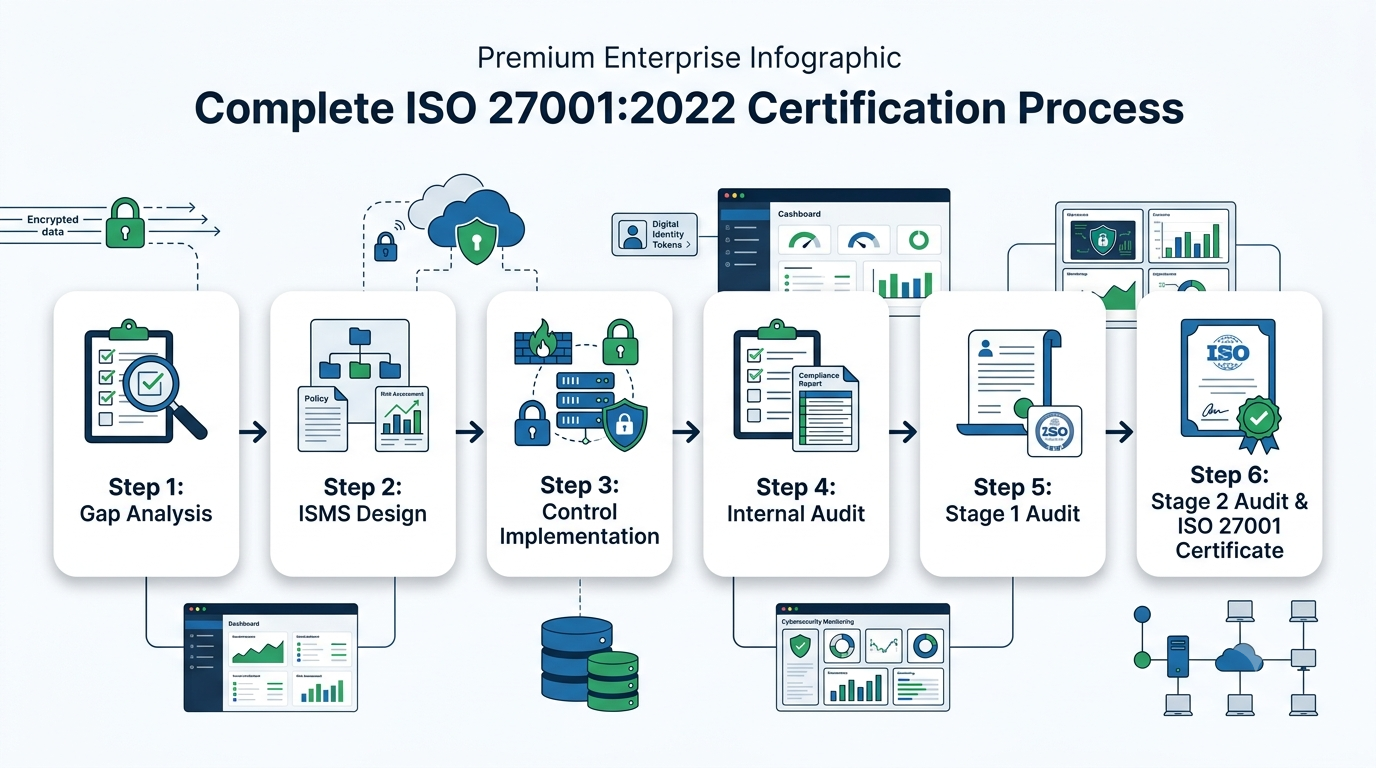
Who Needs ISO 27001 Certification in India?
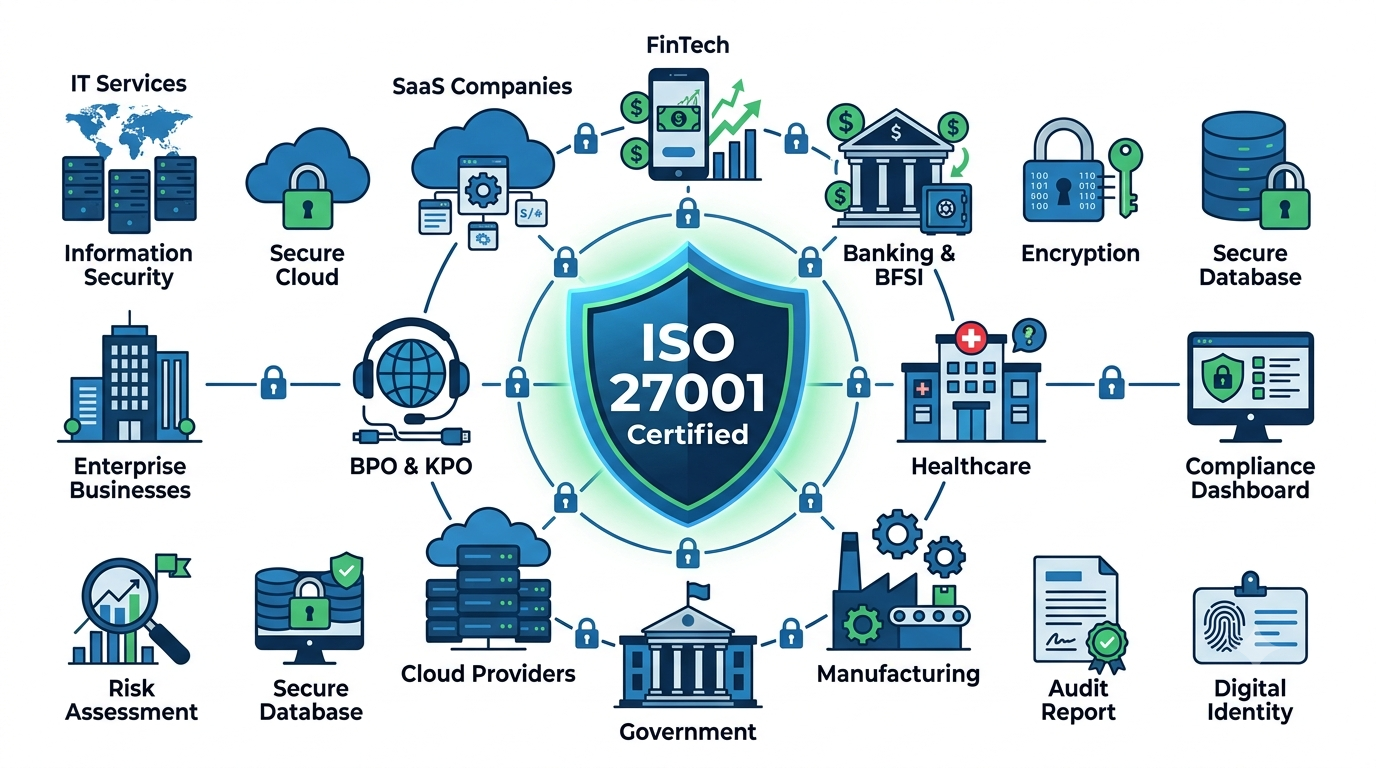
ISO 27001 Certification is not mandatory by law for all Indian businesses, but it has become commercially essential across most sectors where data security is a client or regulatory concern. In 2026, ISO 27001 is increasingly the entry requirement — not a differentiator — for enterprise contracts, global tenders, and regulated sector work.
| Sector | Why It Matters |
|---|---|
| IT services and software companies | Enterprise clients in the US, UK, EU, and Middle East require ISO 27001 as a minimum vendor qualification. Without it, your company fails RFP filters before the technical evaluation even begins. ISO 27001 eliminates the 300-question security questionnaire from each new client relationship. |
| SaaS companies | International SaaS buyers — particularly in the US and Europe — require ISO 27001 alongside or instead of SOC 2. Univate advises on whether ISO 27001, SOC 2, or both are needed based on your specific client geography and buyer profile. |
| Fintech platforms and payment processors | RBI mandates ISO 27001 for Payment Aggregators and banking correspondents. SEBI-regulated entities handling sensitive financial data are expected to maintain ISO 27001 certification. Combining ISO 27001 with PCI DSS gives fintech companies a complete security assurance package. |
| BPOs and KPOs | Global clients require ISO 27001 as a precondition for data processing contracts. Healthcare BPOs and those handling EU data often need ISO 27001 alongside HIPAA or GDPR compliance. |
| Healthcare and pharma | Patient data, clinical trial data, and pharma intellectual property are prime targets. ISO 27001 provides the security governance framework; ISO 27701 extends it to privacy management for organisations also handling personal health data under GDPR or the DPDP Act. |
| Manufacturing and industrial organisations | Industry 4.0, connected manufacturing, and supply chain digitisation all increase information security risk. Enterprise and government buyers increasingly require ISO 27001 from suppliers handling design data, operational technology, and connected systems. |
| Government and public sector | CERT-In requires ISO 27001 for certain government IT projects. Public sector contracts in IT services and data management frequently specify ISO 27001 as a qualification criterion. |
Univate delivers ISO 27001 Certification across India — Delhi, Mumbai, Bangalore, Hyderabad, Pune, Chennai, Gurugram, Ahmedabad — and remotely for distributed organisations and those operating across multiple sites.
ISO 27001 Certification for IT Companies
For Indian IT companies, ISO 27001 Certification is the single highest-return security investment available in 2026. The commercial calculus is clear:
A valid ISO 27001 certificate removes security from the deal cycle. Procurement teams that previously sent 200-question security questionnaires accept the certificate instead, reducing sales cycle length by weeks.
Most Fortune 500 buyers and European enterprise clients filter vendor lists by certification status before technical evaluation. Without ISO 27001, your team's work may never be seen.
Certified firms pay 20–40% lower cyber insurance premiums than uncertified peers with equivalent infrastructure.
ISO 27001 implements 50–60% of the security safeguards required under India's DPDP Act 2023, reducing incremental compliance cost.
Investors and acquirers examine security governance closely. Certified companies command higher valuations and faster closings.
ISO 27001 Certification Cost in India
ISO 27001 Certification cost in India has two components: Univate's consulting and implementation fee, and the accredited certification body's audit fee. Both are covered in Univate's fixed, all-inclusive quote.
Under 50 employees, limited IT scope — gap analysis, ISMS build, documentation, internal audit, and certification body coordination.
50–500 employees, multiple systems — depends on scope complexity, number of sites, and existing security maturity.
Integrated management system implementations covering ISO 27001 + ISO 9001 or ISO 27001 + ISO 22301, costed as a combined programme.
Is ISO 27001 Certification worth it? Yes — for any IT, SaaS, fintech, BPO, or regulated industry organisation in India. It wins enterprise contracts, clears security questionnaires, lowers breach risk, and builds the documented security framework that supports DPDP Act compliance and SOC 2 simultaneously. Univate provides a free gap assessment and a fixed, all-inclusive quote — no surprise fees at the certification audit stage.
ISO 27001 vs SOC 2
Both ISO 27001 and SOC 2 address information security controls, but they serve different markets and produce different outputs.
A certifiable international standard with a formal certificate issued by an accredited certification body. It is globally recognised — particularly strong in Europe, Asia, the Middle East, and for CERT-In/RBI regulatory requirements in India. The certificate demonstrates that your ISMS meets the international standard.
An attestation report issued under the AICPA's SSAE 18 standard by a licensed CPA firm. It is the dominant trust signal in the US market. Enterprise buyers in the US commonly require SOC 2 Type 2 before vendor onboarding, sometimes alongside ISO 27001.
Many Indian SaaS and IT companies pursue both. Univate advises on the right sequencing — typically ISO 27001 first (builds the ISMS and control environment), then SOC 2 (maps to the controls already implemented). Doing both together with Univate reduces total cost by 30–40% versus running separate projects.
Why Choose Univate for ISO 27001 Certification?
Our team holds CISA, CISSP, CCSP, and CMMI credentials and has guided more than 300 enterprises through cybersecurity and compliance programmes. We helped Tahakuf Al Emarat implement an integrated management system spanning ISO 9001, ISO 27001, and ISO 22301 — demonstrating our capability across multi-standard, multi-framework deployments.
What clients get:
ISO 27001 Certification FAQ
How much does ISO 27001 Certification cost in India?
How long does ISO 27001 Certification take in India?
What is the current version of ISO 27001?
Who issues the ISO 27001 certificate?
What is the difference between ISO 27001:2013 and ISO 27001:2022?
What is an ISO 27001 Surveillance Audit?
Does ISO 27001 help with DPDP Act and GDPR compliance?
Get ISO 27001 Certified with Univate
Univate delivers ISO 27001:2022 Certification for organisations across India in IT, BFSI, healthcare, fintech, manufacturing, and BPO — from startups seeking their first enterprise contract to multinationals managing complex multi-site ISMS implementations.
Your certification programme is led by Univate's in-house ISO 27001 Lead Auditor. You get a fixed quote, a fixed timeline, and one team that owns the entire process from gap analysis to certificate — including certification body coordination. Book a free consultation today. We will scope your ISMS, give you a realistic certification timeline, and provide a fixed all-inclusive quote at no obligation.
Call +91 72599 45454Part of: Cybersecurity Services in India