GDPR Compliance Services in India

Contact Us
Univate Solutions delivers end-to-end GDPR compliance services for Indian companies that process personal data of EU residents. Our privacy consultants, holding CISA, CISSP, and CCSP credentials, have guided more than 300 enterprises through GDPR compliance across IT services, SaaS, BPO, fintech, healthcare, and e-commerce. Penalties for GDPR non-compliance reach up to €20 million or 4% of global turnover — whichever is greater. Book a free GDPR gap assessment and get a fixed, all-inclusive quote. Call +91 72599 45454 or WhatsApp us.
What Is GDPR Compliance?
The General Data Protection Regulation (GDPR) is the European Union's comprehensive data protection law, in force since 25 May 2018. It governs how organisations collect, process, store, and transfer the personal data of individuals located in the EU and UK.
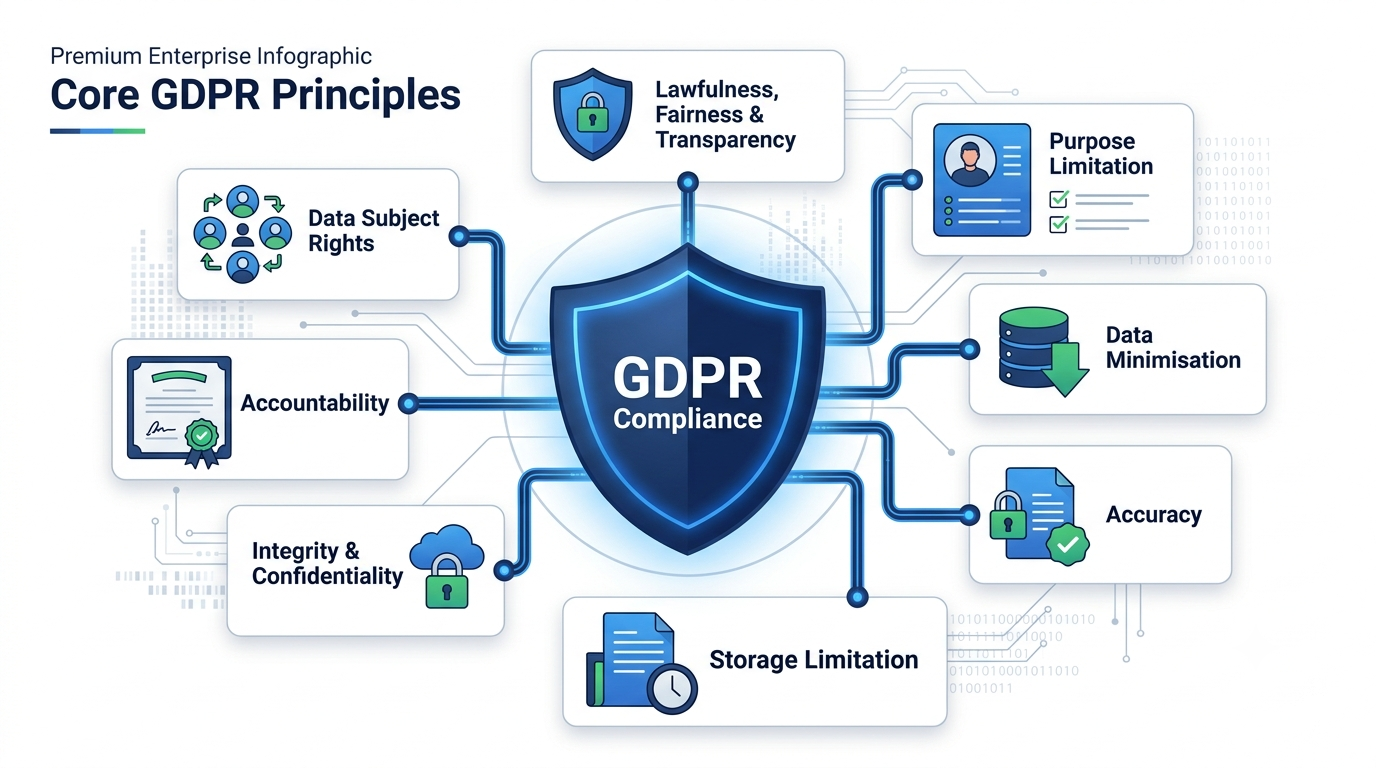
GDPR is built on seven core principles: lawfulness, fairness, and transparency; purpose limitation; data minimisation; accuracy; storage limitation; integrity and confidentiality; and accountability. Organisations must be able to demonstrate compliance with all seven at any time — not just at the point of a regulatory inspection.
Data subjects — the individuals whose data is being processed — hold six enforceable rights under GDPR: the right to access their data, the right to rectification, the right to erasure (the "right to be forgotten"), the right to restrict processing, the right to data portability, and the right to object. Indian companies serving EU clients must build operational workflows to handle these rights requests within the required timeframes.
Does GDPR Apply to Indian Companies?
Yes — and this is the most common misunderstanding among Indian businesses. GDPR's territorial scope is defined by Article 3, not by the location of the organisation. GDPR applies to any organisation processing the personal data of individuals located in the EU or UK, regardless of where the organisation is based. If your Indian company does any of the following, GDPR applies to you:
Even if the service is free.
Website analytics, marketing tracking, user profiling.
As a Data Processor under Article 28.
An Indian IT services company building software for a German bank, a BPO handling customer data for a UK retailer, a SaaS platform with EU subscribers, and an e-commerce business shipping to France are all subject to GDPR.
The Six Lawful Bases for Processing Under GDPR
Before collecting or processing any personal data of EU residents, your organisation must identify and document the lawful basis under Article 6. Using the wrong basis — or relying on blanket consent where a more appropriate basis exists — is one of the most common GDPR violations found in Indian company programmes.
Freely given, specific, informed, and unambiguous. Requires an affirmative action from the data subject. Pre-ticked boxes and bundled consent are not valid. Consent can be withdrawn at any time; your systems must honour withdrawal without disadvantage to the user.
Processing is necessary to perform a contract with the data subject, or to take steps at their request before entering into a contract. Most relevant for SaaS companies processing user account data and e-commerce platforms processing order data.
Processing required to comply with EU or member state law. Relevant for payroll, tax, and employment record processing.
Processing necessary to protect someone's life. A narrow basis rarely applicable outside healthcare emergencies.
Processing in the exercise of official authority or a task in the public interest. Primarily relevant for public bodies.
Processing necessary for purposes pursued by the controller or a third party, balanced against data subject rights. Requires a documented Legitimate Interests Assessment (LIA). Most applicable for B2B marketing, fraud prevention, and network security. Cannot be used for processing by public authorities in the exercise of their tasks.
Key GDPR Obligations for Indian Businesses
GDPR imposes a set of operational obligations on Data Controllers (organisations that determine the purpose of processing) and Data Processors (organisations that process data on behalf of a Controller). Most Indian IT companies, BPOs, and SaaS companies act as both — Controller for their own data, Processor for their clients' data.
Every Data Controller (and large Data Processors) must maintain a written record of all personal data processing activities — categories of personal data, purposes and lawful basis, retention periods, and recipients or transfers. Univate builds and maintains your RoPA as a living document.
When EU personal data flows to India, the transfer requires a valid legal mechanism — primarily SCCs, the model contracts issued by the European Commission. Every Indian company receiving EU personal data needs executed SCCs with their EU counterparties. Univate reviews, drafts, and implements DPAs and SCCs across your supplier and client chain.
Post the Schrems II ruling, transfers to India require not just SCCs but a documented TIA confirming that Indian law does not impede the effectiveness of those SCCs. Univate prepares TIAs for each EU-to-India data flow.
Mandatory when processing is by a public authority, involves large-scale systematic monitoring, or large-scale processing of special category data. Many Indian healthcare companies, BPOs, and fintech platforms trigger this requirement. Univate provides DPO-as-a-Service for organisations that need a DPO without a full-time internal appointment.
Non-EU organisations subject to GDPR without an EU establishment must appoint a representative in an EU member state, acting as the contact point for EU supervisory authorities and data subjects. Univate advises on Article 27 appointments and works with trusted EU-based partners.
Mandatory before processing likely to result in high risk to individuals' rights and freedoms — large-scale profiling, systematic monitoring of publicly accessible areas, or large-scale processing of special category data. Indian healthtech, adtech, and HR software companies regularly trigger DPIA requirements.
Data breaches must be notified to the relevant EU supervisory authority within 72 hours of becoming aware. Where the breach is likely to result in high risk to individuals, affected data subjects must also be notified without undue delay. Univate builds your breach notification playbook and runs tabletop exercises.
GDPR vs DPDP Act — What Indian Companies Need to Know
Many Indian companies assume that implementing DPDP Act compliance automatically satisfies GDPR. It does not. The two laws share vocabulary but differ significantly in architecture and practical obligations.
| GDPR (EU) | DPDP Act (India) | |
|---|---|---|
| Scope | Personal data of EU/UK residents | Digital personal data processed in India |
| Lawful bases | Six (consent, contract, legal obligation, vital interests, public task, legitimate interests) | Primarily consent + deemed consent (legitimate use) |
| Special category data | Explicit categories with additional protections (health, race, biometrics, etc.) | Not yet defined separately |
| Data subject / principal rights | Nine (access, rectification, erasure, restriction, portability, objection, automated decision-making, etc.) | Five (access, correction, erasure, grievance, nomination) |
| Breach notification | 72 hours to supervisory authority | Without delay to DPBI + 72-hour detailed report |
| Cross-border transfers | SCCs, adequacy decisions, BCRs | Government-notified whitelist (pending) |
| DPO requirement | Mandatory in specific scenarios | Only for Significant Data Fiduciaries |
| Maximum penalty | €20M or 4% global turnover | ₹250 crore per incident |
The practical consequence for Indian IT and BPO companies: if you process EU data, you need a GDPR compliance programme. If you also process Indian personal data (which virtually all Indian companies do), you need a DPDP Act compliance programme as well. Univate runs these as an integrated programme — controls that satisfy both frameworks are implemented once, significantly reducing total compliance cost and effort.
The GDPR Compliance Process in India
Univate runs every step of your GDPR compliance programme.
Data Mapping and Records of Processing Activities (RoPA)
We conduct a comprehensive inventory of all personal data your organisation processes — what data, from which EU data subjects, for what purpose, under which lawful basis, shared with which third parties, and retained for how long. This becomes your RoPA and the foundation of every subsequent compliance decision.
Gap Assessment Against GDPR
We benchmark your current practices against the full GDPR requirement set — lawful basis documentation, privacy notices, consent mechanisms, data subject rights workflows, DPA and SCC status, security controls, breach response capability, and DPO/Representative requirements. Each gap is documented with a risk rating tied to the relevant GDPR penalty tier.
Policies, Notices, and Consent Mechanisms
We design and implement compliant privacy notices (Articles 12–14), cookie consent mechanisms meeting ePrivacy requirements, consent management infrastructure, and internal policies covering data retention, data subject rights handling, and security governance.
Data Protection Impact Assessments (DPIAs) Where Required
For processing activities that trigger the DPIA threshold under Article 35, we conduct structured assessments documenting risk identification and mitigation. DPIAs are built into your ongoing governance process for any new high-risk processing activity.
Ongoing GDPR Governance and DPO Support
GDPR compliance is not a one-time project. We establish your ongoing governance framework — annual RoPA reviews, policy updates, staff training, monitoring of EDPB guidance and enforcement trends, breach response drills, and periodic compliance audits. For clients requiring a DPO, Univate provides DPO-as-a-Service on a retained basis.
The GDPR Compliance process in India
Univate runs every step with you.
- Data mapping and records of processing (RoPA).
- Gap assessment against the GDPR.
- Policies, consent, and data subject rights processes.
- Data Protection Impact Assessments where needed.
- Ongoing GDPR governance and DPO support.
Most Indian organisations reach GDPR readiness in 2 to 4 months.
Get in Touch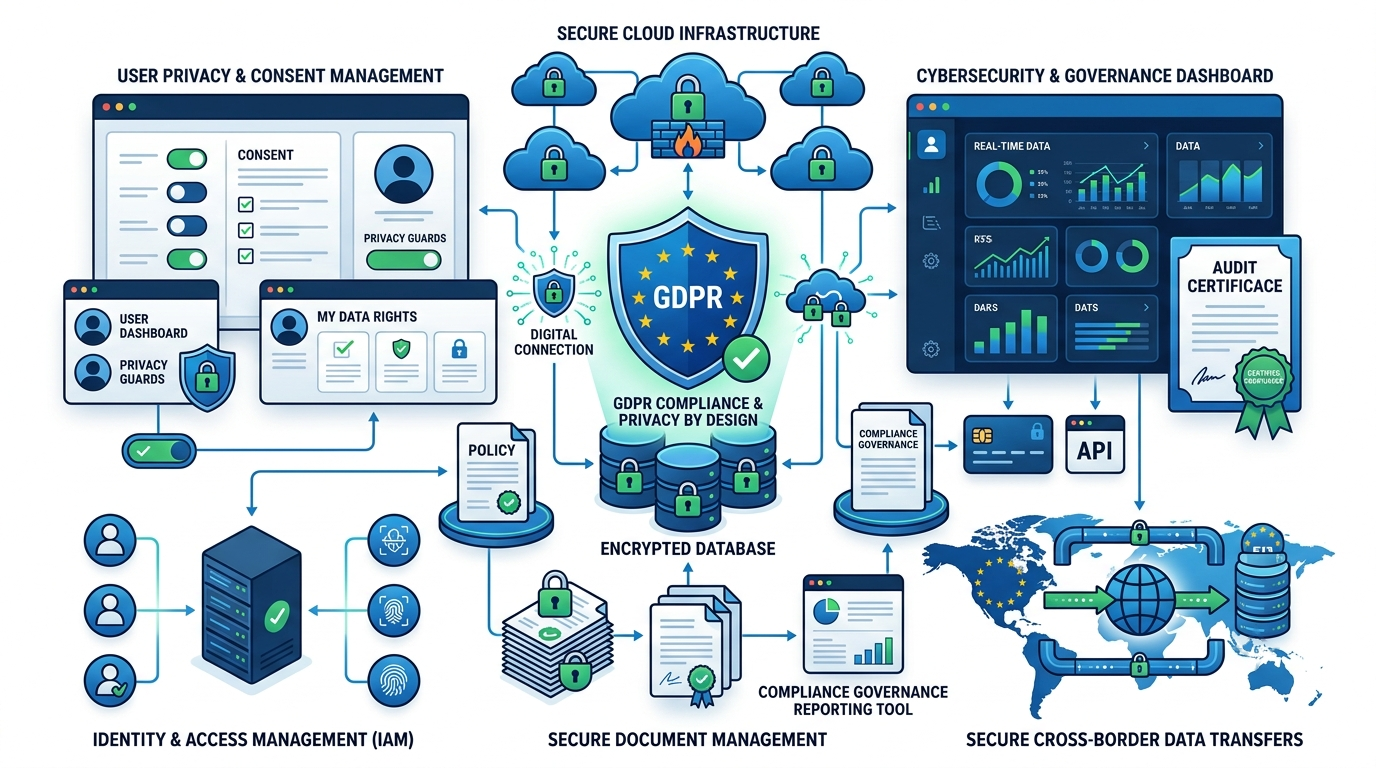
Who Needs GDPR Compliance in India?
Any Indian organisation processing personal data of EU or UK residents must comply — regardless of company size or whether you have a physical EU presence. In practice, GDPR compliance is essential for:
| Who Needs It | Why It Matters |
|---|---|
| IT services and software product companies | Building applications for EU clients or handling EU employee and customer data on their behalf. |
| BPOs and KPOs | Processing HR, customer service, financial, or healthcare data from EU-based clients. If your contract involves EU personal data, a GDPR-compliant DPA is non-negotiable. |
| SaaS companies | Any platform with EU subscribers processes their personal data as a Controller and must comply with all GDPR obligations including privacy notices, consent, data subject rights, and breach notification. |
| E-commerce businesses | Shipping to EU customers, running EU-targeted advertising, or operating a website with EU visitors triggers GDPR applicability. |
| Healthcare and pharma companies | Processing health data of EU individuals (special category data under Article 9) requires explicit consent and heightened security measures. |
| Fintech and payments | Indian fintech companies with EU clients or payment processing involving EU cardholders must maintain GDPR-compliant DPAs with all EU counterparties. |
| Staffing and HR firms | Processing EU employee data on behalf of multinational clients is one of the clearest triggers for both GDPR applicability and DPO appointment. |
Univate delivers GDPR compliance services across India, including Delhi, Mumbai, Bangalore, Chennai, Hyderabad, Pune, and Ahmedabad, as well as for remote-first and multi-location organisations. We also deliver integrated DPDP Act compliance programmes for organisations with both EU and Indian data flows.
GDPR Audit Services in India
A GDPR audit is a structured assessment of your organisation's data processing practices, documentation, technical controls, and governance against the requirements of the General Data Protection Regulation. Univate's GDPR audit services in India deliver the evidence your organisation needs for enterprise client due diligence, EU supervisory authority enquiries, and internal governance.
| Service | What It Covers |
|---|---|
| Gap Assessment Audit | A comprehensive review of your current GDPR compliance posture — lawful basis mapping, RoPA completeness, privacy notice accuracy, consent mechanism validity, DPA and SCC status, breach notification readiness, and DPO/Representative requirements. Delivered with a gap register, risk ratings by penalty tier, and a prioritised remediation roadmap. |
| DPIA Execution | Structured DPIAs for new or existing processing activities that trigger the Article 35 threshold — risk identification, assessment against likelihood and severity, and documentation of mitigating measures. |
| SCC and Transfer Impact Assessment (TIA) Review | Review of all EU-to-India cross-border transfer mechanisms — verification that SCCs are on the current European Commission format, TIAs are documented for each transfer, and sub-processor flow-downs are in place. |
| Vendor and Data Processor Audit | Review of all Data Processing Agreements with vendors receiving EU personal data, assessment of their GDPR compliance posture, and implementation of missing contractual clauses. |
| Ongoing Compliance Audit | Annual GDPR compliance reviews to catch drift — new processing activities not yet mapped, outdated privacy notices, expired consent records, and changes in your vendor ecosystem. |
Univate delivers GDPR audit services for organisations in Delhi, Mumbai, Bangalore, Chennai, Hyderabad, Pune, and Ahmedabad, with full remote audit capability.
GDPR Compliance Cost in India
GDPR compliance cost for Indian companies depends on the volume and complexity of EU personal data processed, the number of in-scope systems and processes, and whether a DPO appointment or EU Representative is required.
Limited EU data processing — gap assessment, privacy notice, consent mechanism, and basic RoPA.
Full GDPR programme — RoPA, DPAs and SCCs, TIA, staff training, DPIA(s), privacy notice overhaul, and breach response.
Complex EU data flows, multiple DPAs, ongoing DPO-as-a-Service, and annual compliance management.
Univate provides a fixed, all-inclusive quote after a free gap assessment. No hourly billing, no scope surprises.
Why Choose Univate for GDPR Compliance in India?
Univate's privacy consultants have guided more than 300 enterprises through information security and data privacy compliance. Our team holds CISA, CISSP, and CCSP credentials and brings cross-framework expertise across GDPR, DPDP Act compliance, ISO 27701 privacy information management, SOC 2 certification, ISO 27001, and HIPAA.
GDPR Compliance FAQ
Does GDPR apply to Indian companies?
What are the GDPR penalties for Indian companies?
Is GDPR compliance the same as DPDP Act compliance?
What is a Data Processing Agreement (DPA) and do we need one?
Do we need a Data Protection Officer (DPO) for GDPR?
What is a Transfer Impact Assessment (TIA) and when do we need one?
How long does GDPR compliance take for an Indian company?
Get GDPR Compliant with Univate
Univate delivers GDPR compliance services for Indian companies across Delhi, Mumbai, Bangalore, Chennai, Hyderabad, Pune, and Ahmedabad — and remotely for distributed organisations. We serve IT services firms, SaaS companies, BPOs, fintech platforms, e-commerce businesses, and healthcare organisations that process the personal data of EU and UK residents.
GDPR enforcement is active and growing — cumulative fines across the EU exceed €7 billion, with enforcement now targeting processors and non-EU companies directly. Every month without a compliant programme is a month of exposure. Book a free GDPR gap assessment today. We will map your EU data flows, confirm GDPR applicability, identify your highest-risk obligations, and give you a fixed, all-inclusive quote on day one.
Call +91 72599 45454Part of: Data Privacy and Compliance in India