


CMMI Level 3 Certification: Process, Requirements, and What Companies Need to Know

Winning enterprise tenders and contract awards comes down to one thing: whether your engineering team can consistently deliver quality without relying on heroics. In most software companies, scale breaks down precisely because heroic effort cannot be sustained — it causes delays and unstable releases.
Understanding the CMMI Level 3 certification process changes that. Reaching a CMMI Defined Level turns your process from an occasional triumph into your organisation's standard way of working — well-structured, well-documented, and well-executed, in a way the international market recognises.
This guide walks through the CMMI Level 3 requirements, the formal CMMI appraisal process, realistic execution timelines, and how to prepare for sustainable, appraisal-ready operations. If you haven't yet, it's worth starting with our overview of the CMMI full form and maturity model for the broader context.
Table of Contents
- What Is CMMI Level 3?
- How CMMI Level 3 Differs from Level 2
- Core CMMI Level 3 Requirements
- Step-by-Step CMMI Level 3 Certification Process
- The Formal CMMI Appraisal Process Explained
- Practical CMMI Level 3 Timeline and Planning
- CMMI vs ISO: Framework Comparison
- Key Takeaways for Business Leaders
- Partner with Univate Solutions
- CMMI Level 3 FAQ
What Is CMMI Level 3? Defining the "Defined" Maturity Level
A CMMI-Defined Level (Maturity Level 3) means your firm has already implemented proactive, standardised process assets across all engineering and management activities — not just within one project team.
Unlike Maturity Level 2, where individual project managers run separate processes, Level 3 means a consistent set of standard procedures applies across the entire firm.
Projects tailor the standard organisational process assets to specific customer needs, while still preserving the quality of service delivery.
Technical and operational dependencies and risks are identified at the very start of the development cycle, not discovered mid-project.
How CMMI Level 3 Differs from Level 2
The move from Level 2 to Level 3 is a meaningful shift in how your business actually operates.
| Dimension | Level 2 — Managed | Level 3 — Defined |
|---|---|---|
| Process scope | Controlled at the project level | Standardised at the enterprise-wide level |
| Problem solving | Resolves problems as they arise during execution | Prevents errors using organisational standards before coding starts |
| Process ownership | Owned by the individual project manager | Owned by an organisational governance team |
Core CMMI Level 3 Requirements
To meet the CMMI Level 3 criteria, software and engineering organisations need standard processes across several operational domains.
Essential Engineering & Management Practices
Technical Solution & Design
Standard processes for system design, architecture, and unit construction.
Verification & Validation
A standard peer code review process, testing process, and acceptance criteria across every sprint cycle.
Integrated Project Management
Plan, execute, and control projects using consistent organisational metrics and standard software estimates.
Decision Analysis & Resolution
Structured criteria for evaluating complex technical decisions, including vendor tools and architecture patterns.
Organisational Process Focus & Governance
Reaching this maturity level also requires dedicated governance mechanisms for continuous improvement.
Explicit leadership directives to measure, plan, and implement process improvements across every department.
An integrated repository of assets — process descriptions, document templates, and flowcharts — maintained centrally.
Ongoing training sessions so every software engineer, project manager, and quality auditor knows the company's standards.
Step-by-Step CMMI Level 3 Certification Process
Successfully leading your team through the CMMI Level 3 certification process is best achieved with a well-planned, multi-phase roadmap that gets your team ready to pass the assessment.
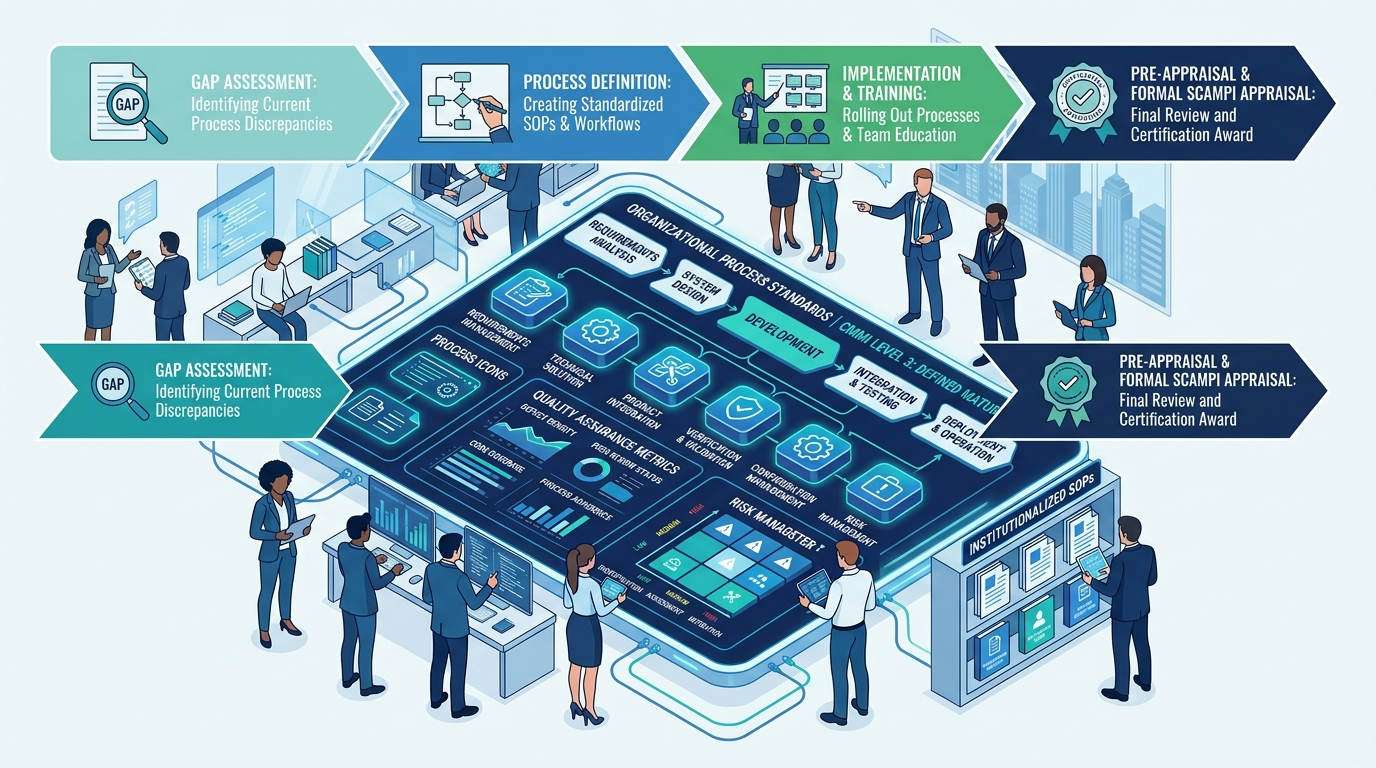
The four-phase roadmap most software companies follow to reach CMMI Level 3.
Phase 1 — Assessing the Situation and Getting the First Impression
Review current working methods
Compare your software development approaches against the industry standard model.
Spot weaknesses and gaps
Note the absence of required work plans, informal reviews, and project tracking without systems in place.
Make the action plan
Lay out improvement steps, choose a process owner, and set realistic execution dates.
Phase 2 — Defining Processes and Writing Documentation
Prepare standard operating guidelines
Write guidelines covering requirement tracking, system design, quality audits, and software release.
Create rules for adaptation
Define the limits within which project teams can adjust processes to meet project-specific needs without violating core policy.
Implement accessible file folders
Make sure teams can access plans, risk documents, review forms, and test case templates from a central document management system.
Phase 3 — Implementation, Training, and Embedding the Standards
Train project teams
Run thorough internal training so developers and project managers understand and apply the new standards effectively.
Test the new processes
Select active development projects and have teams follow the defined process assets in real conditions.
Collect evidence that the process works
Gather peer review logs, risk registers, meeting minutes, and QA department reports as factual evidence.
Phase 4 — Final Check and Pre-Appraisal
Perform an internal mock audit
Run internal reviews to identify remaining points of non-compliance.
Prepare for the SCAMPI appraisal
Confirm every practice is covered, evidence is digitally organised, and the team is ready for confidential interviews about day-to-day work.
Do a last check
Fix any last-minute issues auditors might catch, to align the full body of work with the assessment standard.
The Formal CMMI Appraisal Process Explained
Understanding the formal CMMI appraisal process removes the uncertainty and helps your organisation demonstrate its process capability objectively.
Understanding SCAMPI Appraisal Methodology
Certified appraisers analyse project repositories, source code review documents, design documents, and testing data to confirm process implementation.
Appraisers interview software developers, quality managers, and executives to confirm that documented procedures are actually being followed.
Formal appraisals follow the Standard CMMI Appraisal Method for Process Improvement (SCAMPI), with well-defined rules for data collection, interviews, and ratings.
Role of the Certified Lead Appraiser
The appointed Lead Appraiser directs the appraisal team to ensure complete objectivity throughout the process.
The appraiser confirms every process in the target model scope is genuinely implemented on the representative projects.
After a successful appraisal, the Lead Appraiser submits results to the official registry and issues the rating, valid for three years.
Practical CMMI Level 3 Timeline and Planning
Realistic planning for your CMMI Level 3 timeline helps avoid burnout and keeps implementation running smoothly alongside your ongoing engineering projects.
Discovery and Design
Run the gap assessment, form process governance teams, and write standard operating procedures.
Implementation and Training
Train teams on the new processes, deploy standard assets into live projects, and gather metrics baselines.
Verification and Mock Audits
Run internal reviews, a pre-appraisal evidence audit, and refine project documentation.
Formal Benchmark Appraisal
Complete the official appraisal with a certified Lead Appraiser and receive your formal maturity rating.
Factors That Influence the Rate of Implementation
Firms already running ISO standards or structured Agile methodology tend to define processes faster.
Resource allocation from leadership directly influences how quickly teams adopt new processes.
Single-location software teams typically reach readiness faster than distributed, international ones.
CMMI vs ISO: Framework Comparison
Software executives commonly compare CMMI against general management standards when planning process change.
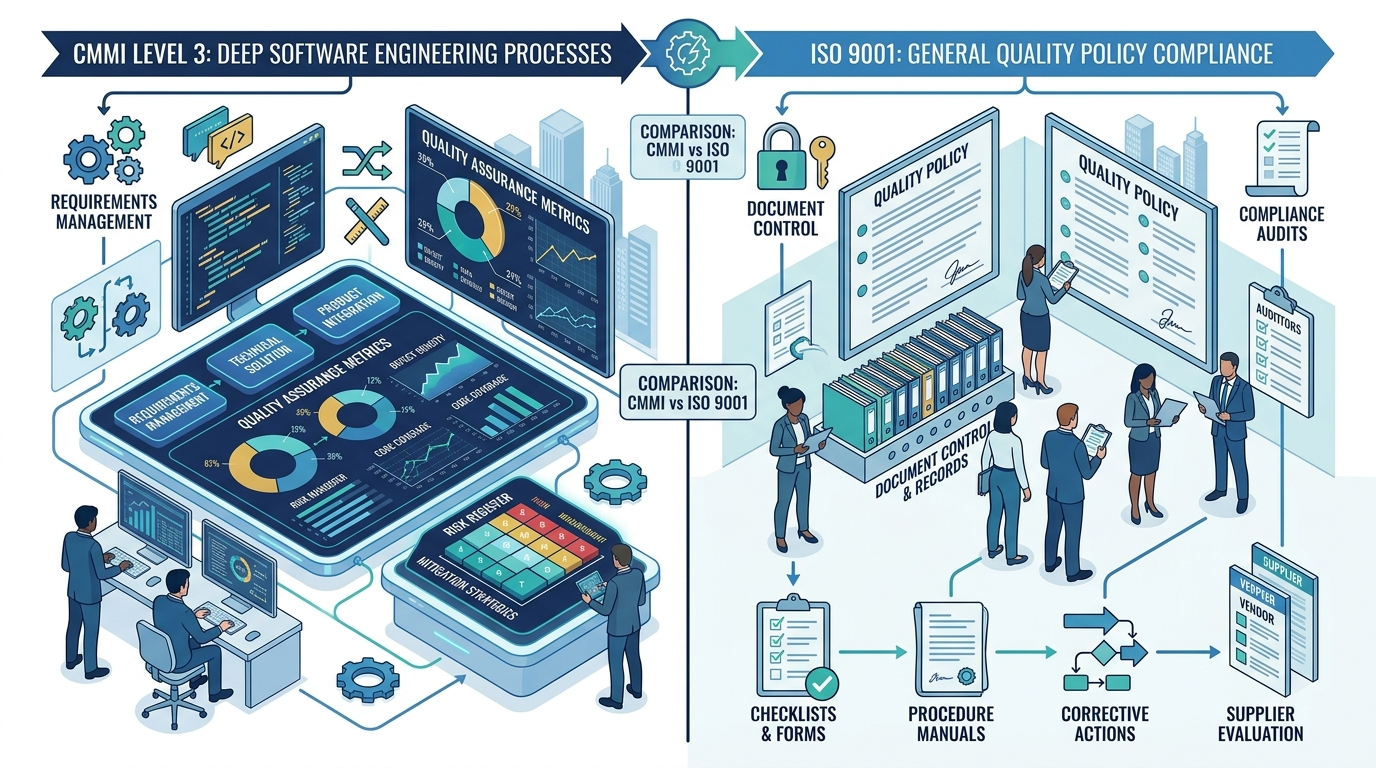
CMMI Level 3 and ISO 9001:2015 solve different, complementary problems.
| Feature Area | CMMI Level 3 (Defined) | ISO 9001:2015 |
|---|---|---|
| Primary scope | Software, systems engineering, and project management | General organisational quality management system |
| Process focus | Engineering depth, quantitative estimation, and risk management | Customer satisfaction, policy adherence, and vendor management |
| Implementation | Organisation-wide process tailoring and standardised engineering | Document control, management reviews, and audit checklists |
| Evaluation method | Benchmark appraisal by a certified Lead Appraiser | Pass/fail certification audit by a registrar |
| Target outcome | Process maturity and predictable engineering delivery | Certified compliance to global quality standards |
Key Takeaways for Business Leaders
Reaching a CMMI Defined Level means turning individual project successes into predictable, enterprise-level operations.
Meeting the CMMI Level 3 requirements means integrating technical engineering practices with solid organisational process practices.
A systematic approach to CMMI Level 3 certification drives high adoption without disrupting software sprint cycles.
Succeeding at the formal CMMI appraisal process through a SCAMPI appraisal proves your process capability to enterprise buyers objectively.
Planning for a 9 to 12-month CMMI Level 3 journey gives your team enough time to genuinely embrace new processes.
Engaging experienced CMMI consulting partners reduces implementation risk and accelerates appraisal readiness.
Partner with Univate Solutions for Seamless CMMI Certification
Mature processes should help you deliver faster — not overwhelm your development team with unnecessary bureaucracy. At Univate Solutions, we help IT, software, and engineering teams build process maturity and predictable delivery capability.
As your CMMI consulting India partner, we manage your entire process maturity journey from start to finish. Under our in-house certified Lead Appraiser, your team goes through gap analysis, process asset development, interactive training, and the final benchmark appraisal. We tailor the CMMI process model to your existing Agile or DevOps workflow, so your team keeps its sprint velocity while building real process discipline. We also support CMMI Level 5 high-maturity training for teams planning their next step, and both CMMI-DEV and CMMI-SVC process models.
Whether you're pursuing CMMI Level 3 for enterprise and government tenders or improving internal engineering execution, we deliver across Noida, Gurugram, Mumbai, the USA, the UAE, and Malaysia — with a clear roadmap and transparent pricing.
Schedule Your ConsultationWhy Software Companies Choose Univate for CMMI Level 3
CMMI Level 3 Certification FAQ
What does CMMI Level 3 (Defined) actually mean?
How is CMMI Level 3 different from Level 2?
How long does CMMI Level 3 certification take?
What is a SCAMPI appraisal?
Who can issue a CMMI Level 3 rating?
Does CMMI Level 3 replace ISO 9001?
Can CMMI Level 3 work alongside our existing Agile or DevOps process?
Ready to Move from Occasional Wins to Organisational Standard?
Univate Solutions runs your entire CMMI Level 3 journey — gap analysis, process asset development, training, and the final SCAMPI appraisal — led end to end by our in-house certified Lead Appraiser.
Call +91 72599 45454



Trackbacks/Pingbacks