CMMI Full Form Explained: What It Means and Why It Matters for Software Companies
Every software company eventually hits a growth barrier. Projects slip their timelines, small defects escape quality checks and reach production, and your best developers burn out firefighting problems that a stronger process would have caught early. Once customer complaints stack up, it becomes clear that hard work alone cannot fix a structural, operational bottleneck.
To build a scalable software business, your processes have to be predictable. CMMI full form stands for Capability Maturity Model Integration. Created by Carnegie Mellon University and maintained worldwide by the CMMI Institute, CMMI is an international process improvement framework that standardises development, optimises project workflows, and turns unpredictable teams into reliable engineering engines.
If your business is chasing large enterprise clients or government contracts, understanding the CMMI full form is where that journey starts. This guide walks through how the CMMI maturity model works, what it takes to get appraised, and the advantages it offers compared with other certifications like ISO 9001.
Table of Contents
- What Is the CMMI Full Form and Its Core Origin?
- Key Components of the CMMI Framework
- The Role of the CMMI Institute
- Decoding the 5 Levels of the CMMI Maturity Model
- Core Organisational Process Areas in CMMI
- CMMI vs ISO: Choosing the Right Framework
- Why CMMI Matters for Growing Software Companies
- How the CMMI Appraisal Model Works
- Step-by-Step Implementation Strategy
- Key Takeaways for Readers
- Why Scale with Univate Solutions
- CMMI FAQ
What Is the CMMI Full Form and Its Core Origin?
CMMI stands for Capability Maturity Model Integration. It began at Carnegie Mellon University's Software Engineering Institute and is now maintained globally by the CMMI Institute, which is part of ISACA. The framework gives software and systems organisations a structured way to assess and improve how they plan, build, test, and deliver — regardless of which methodology (Agile, Waterfall, DevOps) they use day to day.
Key Components of the Framework
CMMI creates a common, organised way of working across every project team, so quality does not depend on which team happens to be assigned to a client.
Applying the Capability Maturity Model Integration approach helps teams surface project risks before a single line of code is written, rather than discovering them mid-sprint.
It gives growing software companies a way to maintain consistent product quality even as headcount, teams, and client accounts multiply.
The Role of the CMMI Institute
The CMMI Institute owns and governs the model globally, and its role goes well beyond publishing a document — it keeps the framework current and controls who is authorised to appraise organisations against it.
The Institute updates CMMI practices to stay aligned with today's Agile, DevOps, and cloud delivery approaches, so the model does not fall behind how software is actually built in 2026.
It certifies independent Lead Appraisers, who are the only professionals authorised to conduct official benchmark appraisals and issue a valid maturity rating.
Authorised partners, like Univate, guide organisations through structured gap analysis and the appraisal process under the Institute's governance rules.
Decoding the 5 Levels of the CMMI Maturity Model
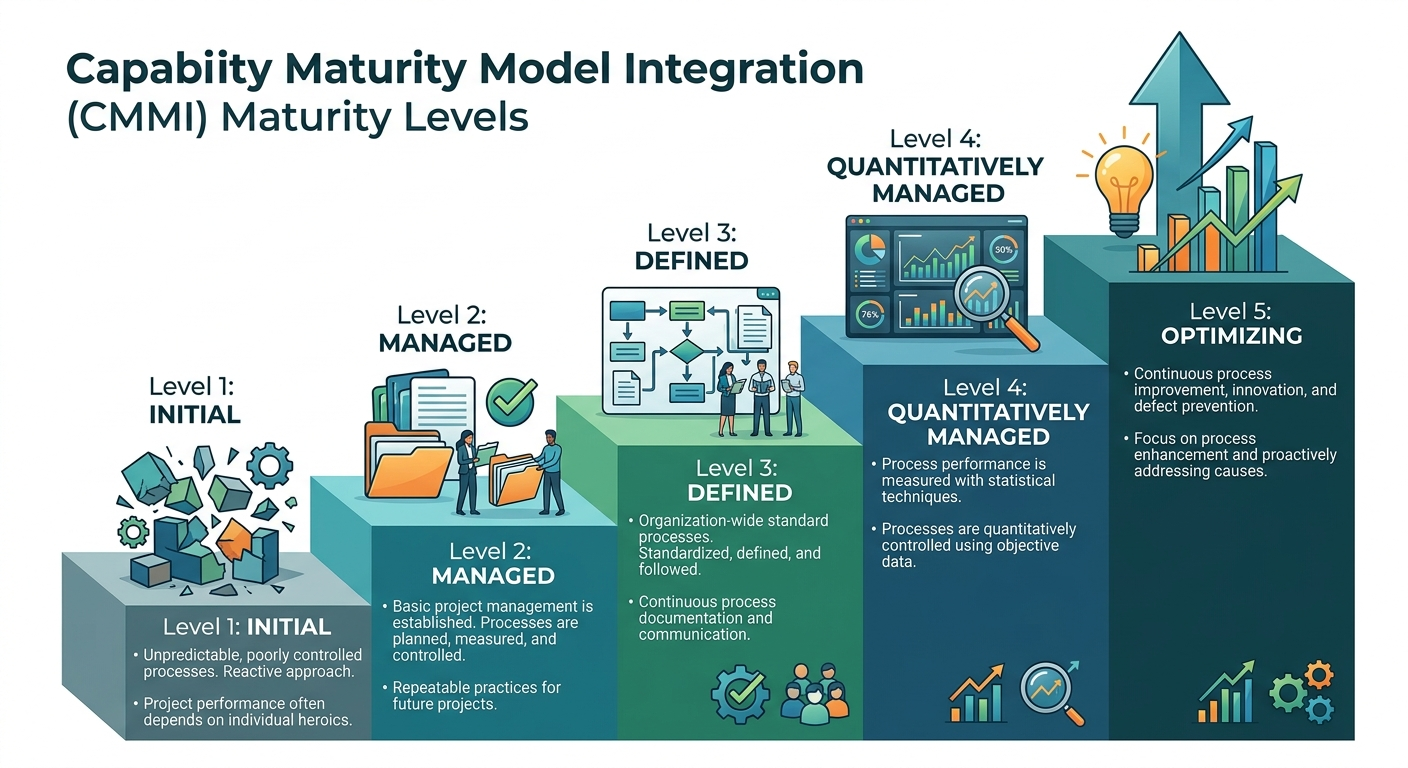
The CMMI maturity model describes an organisation's evolution through five stages. Every level is a step towards more stable processes and more predictable delivery — and each one builds directly on the level before it.
The five CMMI maturity levels, from Level 1 (Initial) to Level 5 (Optimizing).
Initial — Hero-Driven Workflows
Delivery depends on individual skill and improvisation rather than a defined process.
- Projects run late and over budget because there is no estimation standard
- Quality is unpredictable and varies between project managers and developers
Managed — Structured Planning
Teams define requirements management, feasible schedules, and budget tracking.
- Fundamental quality assurance checks the product before every release
- Basic project discipline replaces ad hoc, hero-driven delivery
Defined — Organisation-Wide Standards
Practices are documented and applied consistently across the whole business, not just within individual projects.
- Projects of similar scope reliably produce similarly successful results
- Project teams tailor the organisation's standard process to each client's needs
Most enterprise and government tenders require at least CMMI Level 3 certification as a baseline.
Quantitatively Managed — Statistical Process Control
Process performance is measured with quantitative indicators instead of gut feel.
- Teams produce reliable timeline and defect estimates within statistical limits
- Managers make data-driven decisions based on evidence, not instinct
Optimizing — Continuous Improvement
The organisation examines root causes of defects to prevent recurring bugs permanently.
- Teams can safely experiment with new engineering tools, automation, and structures
- Process improvement becomes an ongoing discipline, not a one-off project
Reaching this stage means pursuing CMMI Level 5 high-maturity training and certification.
Core Organisational Process Areas in CMMI
The Capability Maturity Model Integration setup groups an organisation's most important engineering activities into focused areas. Operating these process areas effectively is what lets your teams make consistent, balanced progress across the whole business.
1. Project Management and Planning
Preliminary project activities
Get a clear picture of the work to be done — scope, team size, cost, duration — and identify risks and constraints upfront.
Risk mitigation
Surface technical dependencies and security threats during the planning stage, before they become expensive to fix.
Performance monitoring
Track milestone completion against key performance indicators throughout delivery.
2. Engineering and Technical Execution
Requirement gathering and analysis
Break requirements down so they stay traceable through design and code, and verify them by running and observing the software against real scenarios.
Technical architecture and solution design
Build a well-documented, clearly structured solution that can evolve as the system changes.
Verification and validation
Test functionality and real user scenarios thoroughly after development, not just before release.
3. Process and Quality Assurance
Quality control checks
Confirm the development team is following company processes correctly through structured quality control checks.
Configuration control
Track code releases, versions, related documentation, and changes securely and consistently.
Performance data
Gather real performance data so executives can make informed decisions, backed by evidence.
CMMI vs ISO: Choosing the Right Framework
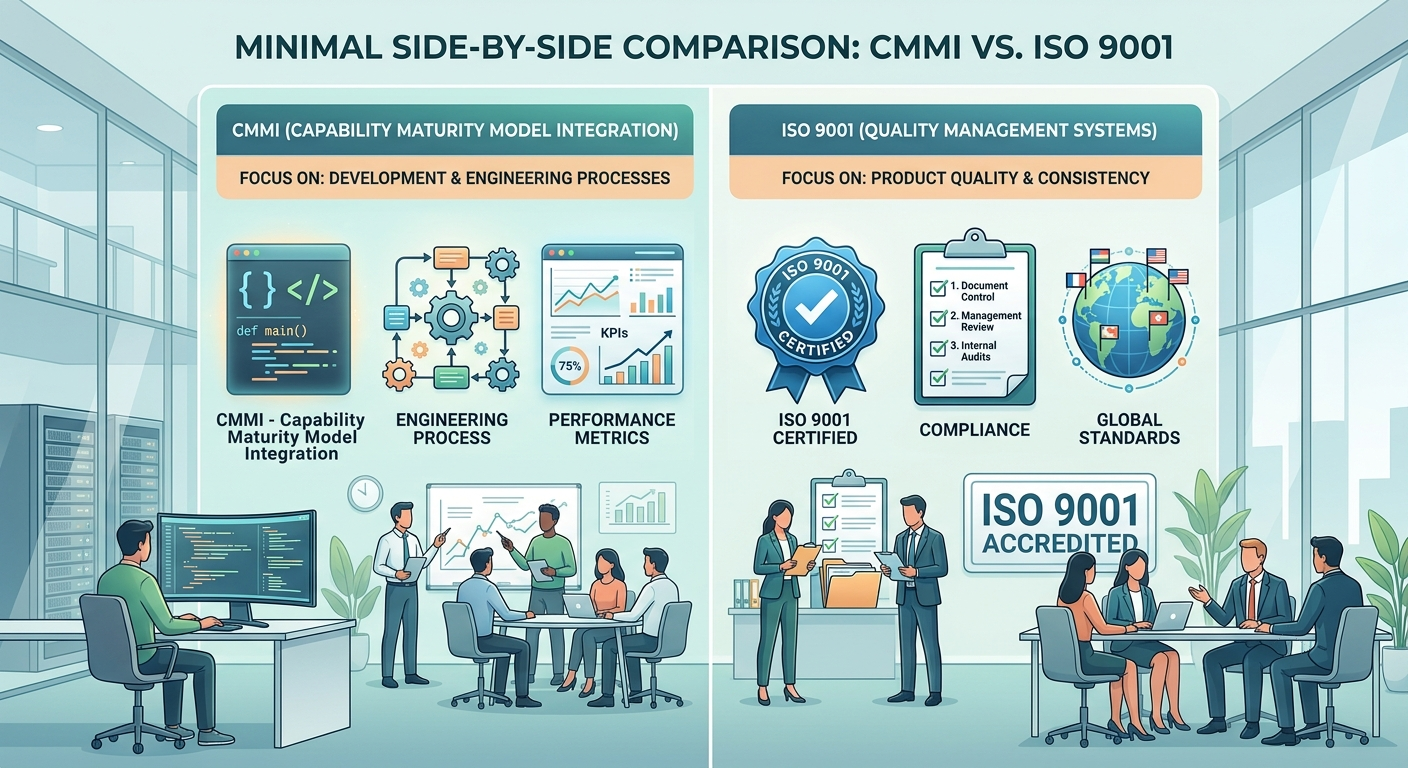
Software executives frequently weigh the CMMI maturity model against ISO management standards. Both improve organisational performance, but their operational objectives differ significantly.
| Feature | Capability Maturity Model Integration (CMMI) | ISO 9001:2015 Framework |
|---|---|---|
| Primary focus | Engineering execution and software process improvement | Generic quality management system (QMS) standards |
| Industry target | IT, software engineering, systems design, and defence | Manufacturing, services, logistics, and general business |
| Evaluation method | Staged maturity levels (Level 1 to Level 5) | Pass/fail compliance certification audit |
| Implementation scope | Deep technical workflows and organisational process areas | Broad organisational governance and document controls |
| Measurement style | Quantitative performance metrics and statistical controls | Audit checklist compliance and policy adherence |
Why CMMI Matters for Growing Software Companies
Understanding the CMMI full form is only the starting point — what matters to executives is the strategic market access that process maturity actually unlocks.
Winning Enterprise & Government Deals
- Corporate and government tenders often mandate CMMI Level 3 compliance
- International enterprises treat a certified maturity level as evidence of delivery reliability
- Mature software companies close bigger deals by demonstrating lower execution risk
Minimising Rework & Waste
- Peer reviews and testing catch defects early, reducing the cost of fixing them later
- Data-driven estimation keeps budgets and scope from creeping beyond agreed limits
- Reliable delivery improves customer loyalty and lifetime value
Building a Scalable Engineering Team
- Documented processes get new developers productive faster
- Standardisation removes over-dependence on a handful of senior employees
- Well-structured sprint planning helps prevent burnout and attrition
How the CMMI Appraisal Model Works
A maturity rating is only officially granted once your organisation completes a formal CMMI appraisal under the official appraisal framework.
Phase 1 — Appraisal Readiness and Pre-Assessment
Detailed gap analysis
Official appraisers evaluate your current software development processes against the target maturity level's requirements.
Process realignment
Your quality team updates SOPs to close the compliance gaps identified during the review.
Evidence collection
The engineering team gathers project documentation — code reviews, meeting logs, and testing logs — as appraisal evidence.
Phase 2 — The Official Benchmark Appraisal
Artifact evaluation
Official appraisers audit project documentation to confirm adherence to defined processes.
Interviews
Appraisers interview developers, project managers, and business executives to verify process compliance in practice, not just on paper.
Publication of ratings
The organisation receives an official maturity rating, valid for three years.
Step-by-Step Implementation Strategy for Software Teams
Moving to a new maturity level needs a roadmap across multiple stages — it is rarely a single project.
1. Process Readiness Evaluation
Set maturity objectives
Decide whether your business needs Level 2, Level 3, or Level 5 maturity based on your client base and contract requirements.
Seek out experts
Work with experienced partners to run the initial gap analysis accurately.
Choose quality champions
Identify people inside your organisation who will own reaching the maturity objectives.
2. Implementation and Education
Create SOPs
Give developers and project managers documented guidelines that actually work in practice.
Educate project managers
Make sure project leaders understand how to apply quality standards without slowing delivery down.
Control initial projects
Run pilot projects to test and refine your process guidelines before rolling them out organisation-wide.
Key Takeaways for Readers
The full form of CMMI is Capability Maturity Model Integration, overseen internationally by the CMMI Institute.
The CMMI maturity model takes organisations from Initial (Level 1) through to Optimizing (Level 5).
Unlike broad standards such as ISO, CMMI addresses software process improvement and engineering execution specifically.
Standardising organisational process areas improves estimation, risk management, and code quality.
A maturity level rating is only official once your organisation passes a formal appraisal under the CMMI appraisal model.
CMMI helps software firms win larger contracts, reduce rework expenses, and scale predictably.
Scale Your Software Operations with Univate Solutions
Learning the CMMI meaning is only the first step — implementing the Capability Maturity Model Integration in a real engineering department takes hands-on delivery skill. At Univate Solutions, we help software firms turn a complex process model into working practice that supports real growth.
Our project is led by an in-house certified Lead Appraiser, so your organisation builds mature organisational process areas, earns its target maturity rating, and passes appraisals smoothly. We support CMMI-DEV for product engineering teams and CMMI-SVC for service delivery organisations, and we deliver across Noida, Gurugram, Mumbai, the USA, the UAE, and Malaysia.
Whether your team needs Level 3 to win enterprise software contracts or Level 5 high-maturity execution, we support every stage of the journey.
Contact Our Lead Appraisal TeamWhy Software Companies Choose Univate for CMMI
CMMI Full Form & Certification FAQ
What is the CMMI full form?
How many levels are in the CMMI maturity model?
What is the difference between CMMI and ISO 9001?
Why do enterprise and government tenders ask for CMMI Level 3?
How long is a CMMI maturity rating valid?
Who conducts a CMMI appraisal?
Does my company need CMMI-DEV or CMMI-SVC?
Ready to Reach Your Target CMMI Maturity Level?
Univate Solutions helps software companies move from unpredictable, hero-driven delivery to a mature, appraisal-ready engineering organisation — led end to end by our in-house certified Lead Appraiser.
Call +91 72599 45454